
Clapilot-Agent Memory
Native runtime memory architecture, retrieval, flushing, and compaction.
Memory explained visually
These raster diagrams are generated documentation assets and are paired with exact captions below so the page is readable even when a tiny in-image label is hard to inspect.
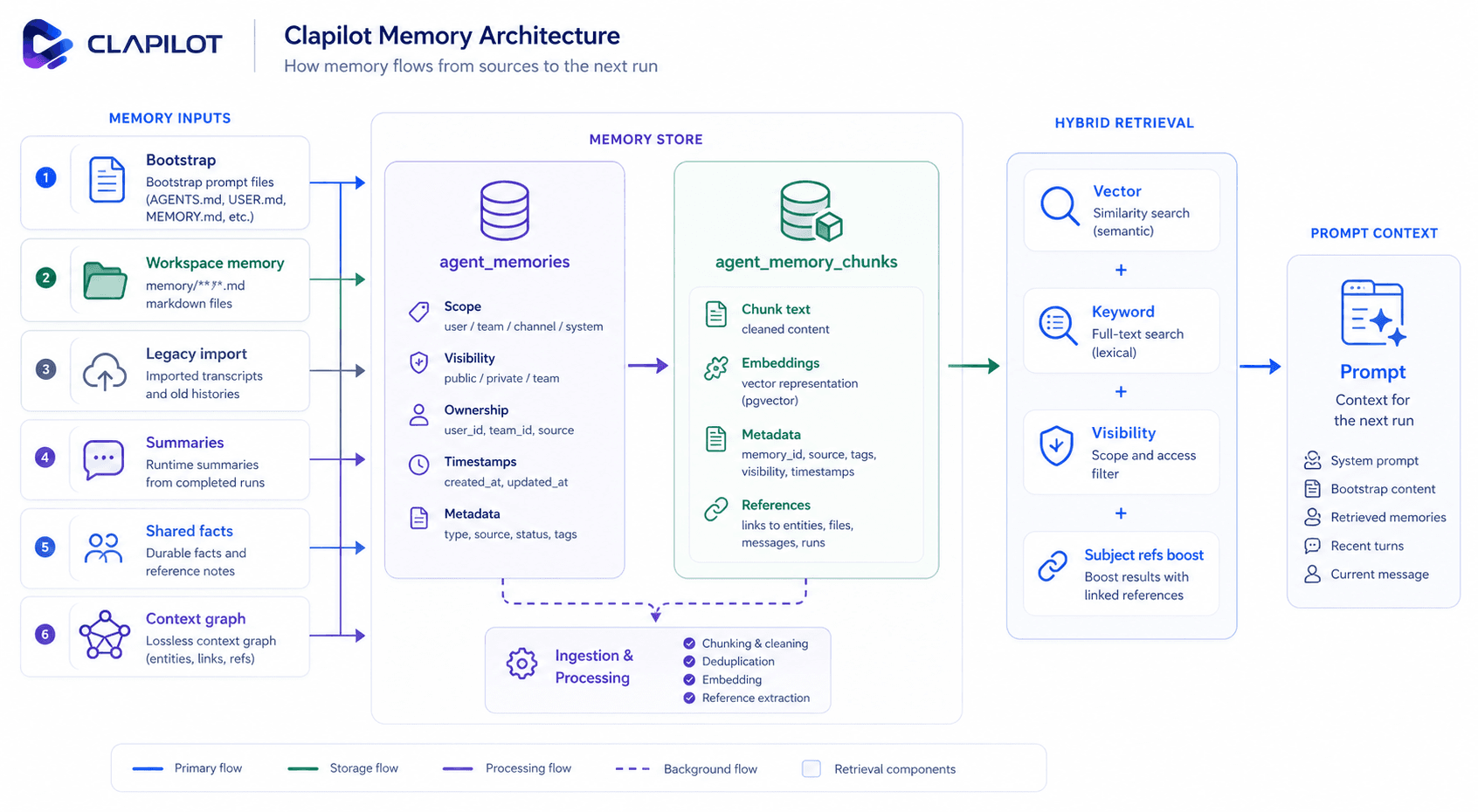
Shows bootstrap files, workspace memory, imported transcripts, summaries, shared facts, and context graph entries flowing into memory storage and retrieval.
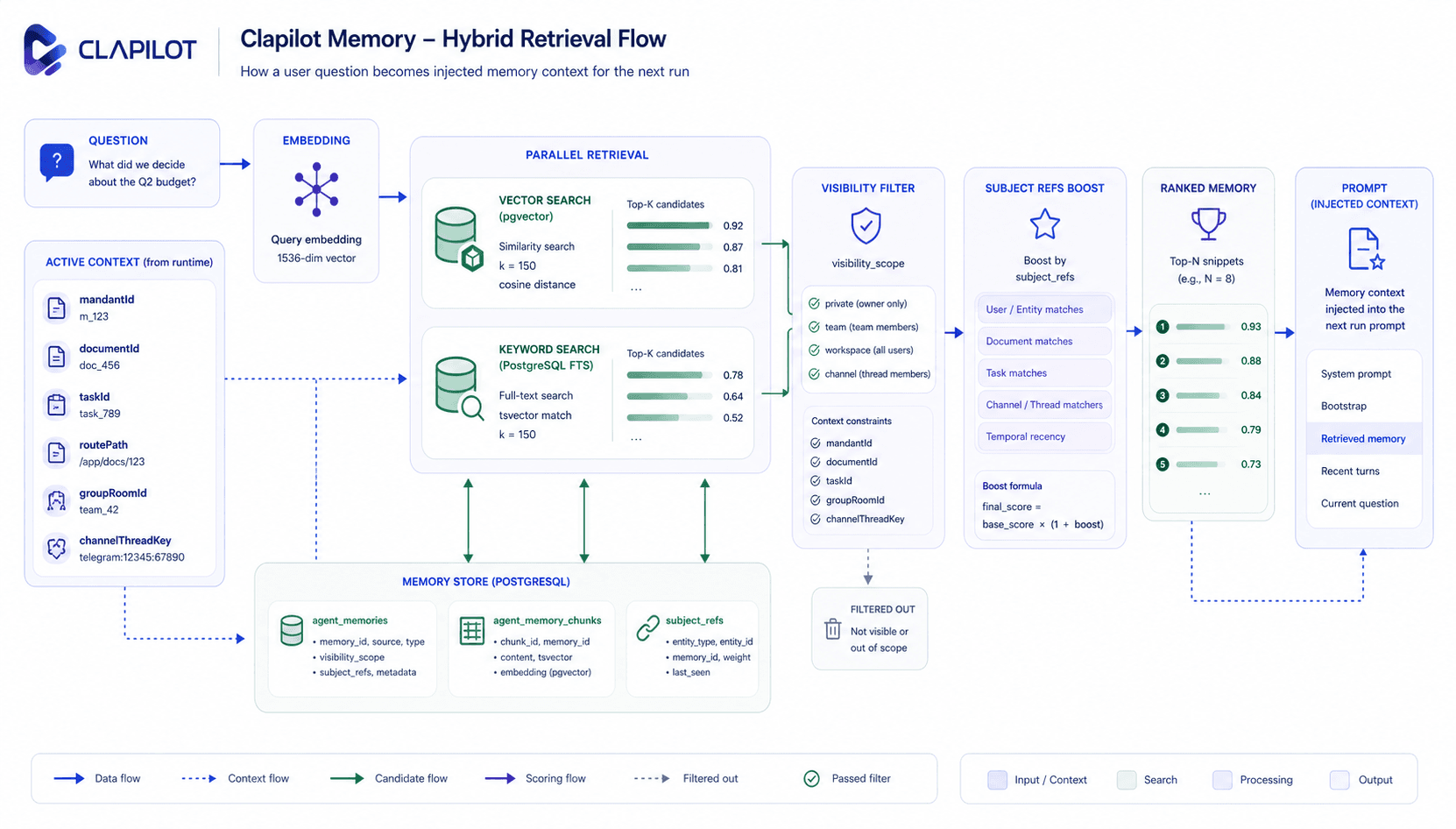
Explains the exact retrieval path: question, active context, embedding, vector search, keyword search, visibility filtering, subject boosting, ranked snippets, and prompt injection.
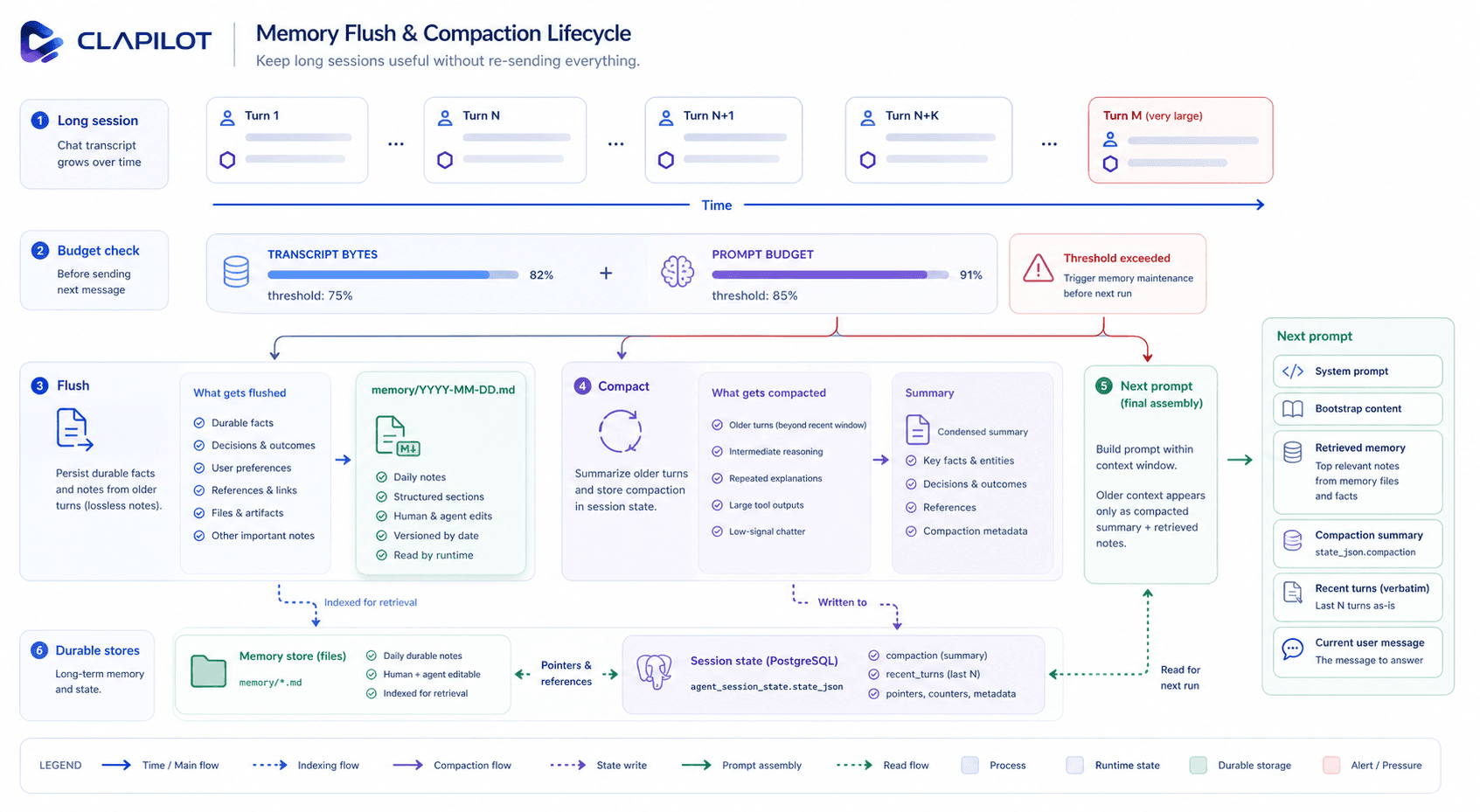
Shows when transcript growth triggers durable memory flushing, session compaction, recent-turn preservation, and final context-window fitting.
The native clapilot-agent service has its own durable memory layer. Memory is intentionally split into several parts because they solve different problems:
- bootstrap files tell the agent who it is and how the workspace works
- canonical assertions let policy-activated or human-reviewed, source-backed knowledge survive across sessions
- session history keeps the current conversation coherent
- compaction keeps long conversations inside the model budget
- vector and keyword retrieval make old knowledge findable without replaying everything
It now combines file-based bootstrap context from the shared workspace, a PostgreSQL Memory v2 assertion/evidence ledger, compatibility and retrieval projections in agent_memories, a source-backed knowledge graph, a lossless per-session context graph, vector retrieval (embedding similarity via the pgvector Postgres extension), keyword retrieval (Postgres full-text search), and a session maintenance pipeline that can flush durable facts before history compaction (compaction = summarizing older turns so long conversations still fit the model budget).
Memory Dreaming v2 adds a background curation layer on top of those stores. It partitions active DB-backed inputs by their exact audience boundary, asks the configured maintenance model for schema-constrained source-backed assertions and Wiki proposals, and validates exact source ids and evidence excerpts. Every persisted Dream assertion receives an immediate system-policy decision: safe, durable, evidence-backed facts, preferences, decisions, constraints, and procedures at the configured confidence threshold activate automatically; unsafe, secret-bearing, volatile, or non-durable outputs are rejected automatically, while merely not-auto-approvable outputs (missing trusted source or evidence, low confidence, open conflicts, time bounds, review-only change kinds) stay as reviewable candidates instead of being rejected. System, heartbeat, webhook, scheduled-task, and other automation runtime sessions are excluded from Dreaming input, while automation decisions stated by a person in Team Chat remain normal human evidence. Active assertions receive embeddings and compatibility projections, and only active approved assertion projections feed the Knowledge Graph. Wiki output always remains a review proposal and is never auto-approved or published by Dreaming. Prompt files, workspace Markdown files, and cited source rows stay authoritative and are not rewritten by Dreaming v2.
The learning object store builds on this memory model but remains a separate control-plane feature. Approved learning objects can be injected as their own prompt layer with visibility checks and audit events, and the post-response shared-facts pass can create canonical Learning projections. Safe, evidence-backed facts and preferences activate automatically under the opt-out policy; procedure drafts, corrections, conflicts, unsafe content, and other exceptions require review. The protected Learning Curator uses the model selected on /geplante-aufgaben to inspect only new or changed canonical facts. It keeps by default and rejects only high-confidence false, unsafe, duplicate, non-durable, or clearly worthless content. Learning objects are not part of the writable memory tool surface; agents use the unified context_search / context_get retrieval facade first and can fall back to learning_search / learning_get_object for Learning-only inspection. Durable facts, procedure/skill proposals, hot memory snapshots, approval state, audit state, scopes, and token-cost attribution are documented in Learning Contracts.
Lossless context compaction isolation
Lossless graph compaction snapshots source rows without holding a database client during provider setup or inference. Each memory module admits at most two compactions and one per session; excess work retains raw context for a later turn. Provider work has an aborting deadline capped at 90 seconds. A short post-inference transaction shares the context-appender advisory-lock key, revalidates all source items, and commits summary, provenance links, and item replacement atomically. Busy or stale work is skipped. Original messages remain available, including after timeout fallback. See the production pool incident for the regression suite and operational checks.
What the runtime treats as memory
There are six practical memory inputs:
- bootstrap files from the shared workspace:
AGENTS.md,IDENTITY.md,SOUL.md,USER.md,MEMORY.md,TOOLS.md;MEMORY.mdremains editable and indexed but is excluded from prompt-file injection by default - workspace memory files under
memory/**/*.md(read-only input: the runtime syncs them into the database but never writes them) - runtime-written memory-flush entries stored directly as
source_type = flushrows - runtime-written shared facts and their canonical assertions/evidence, plus explicit user-directed writes via the
memory_storetool - source-backed knowledge graph entities, claims, edges, and evidence extracted from dream memories
- lossless session-context messages and summaries in the context graph tables
At run time the agent bootstraps from:
- prompt-file context
- the precomputed per-user profile (static facts plus dynamic recent context)
- approved canonical assertions plus compatible durable-memory projections relevant to the current ask
- retrieved structured knowledge graph context relevant to the current ask
- recent conversation history
- an optional persisted compaction summary from older turns
CLAPILOT_AGENT_EXCLUDE_MEMORY_MD defaults to true. Set it to false only when an installation deliberately needs the legacy direct MEMORY.md prompt layer. The file stays in PROMPT_FILE_CANDIDATES, the Bootstrap-Dateien editor, workspace synchronization, and searchable memory projections regardless of this prompt flag.
For explicit agent lookups, context_search is the preferred broad read path. It searches approved Learning objects, Wiki pages, canonical assertions/durable memory, exact session-history/session-summary hits, and the Knowledge Graph together. Results are merged with reciprocal-rank fusion using canonical assertion/topic identities, a small confidence contribution, and a reserved slot per contributing source before the final limit. Use context_get on returned ids before relying on a fact for source-backed Wiki writing or provenance-sensitive answers; use lower-level memory_*, learning_*, wiki_*, and knowledge_* tools only for drill-down or writes.
External coding-agent access
Developer API keys can expose the native durable-memory layer to an external MCP server or a Codex/Claude skill without granting an interactive Clapilot session:
memory:readauthorizes semantic search atGET /api/v1/memory?query=...and exact retrieval atGET /api/v1/memory/{id}memory:writeauthorizes explicit durable-memory submission atPOST /api/v1/memory- both scopes are independent and bound to the user who created the key
- search and exact reads still apply active-state, approval, instance, audience, and visibility filters
- writes call
storeManualMemory; they do not bypass safety checks, audience derivation, sharing preferences, content-hash deduplication, assertion review, Learning projections, or embeddings
The bundled scripts/clapilot-memory-mcp.mjs stdio adapter exposes three narrow tools: clapilot_memory_search, clapilot_memory_get, and optional clapilot_memory_store. Search/get are listed only when CLAPILOT_MEMORY_READ_TOKEN (or its read-only CLAPILOT_MEMORY_TOKEN alias) is configured; store is listed only when the separate CLAPILOT_MEMORY_WRITE_TOKEN is present. This makes durable mutation an explicit operator opt-in even when the adapter is installed globally.
The shared workspace-seed/skills/clapilot-memory/SKILL.md works in Codex and Claude Code. It defines when retrieval is relevant, requires exact retrieval before consequential reliance, defaults writes to private, and excludes secrets, raw logs, speculation, transient task state, and repository-owned implementation facts from storage. Returned memory content is always marked and treated as untrusted data; it must never be promoted into system or developer instructions. Setup commands and environment variables are in the skill's references/setup.md. Full request and response shapes remain documented in API Reference.
Implementation entrypoint:
services/clapilot-agent/src/memory/index.mjs
External MCP entrypoint:
scripts/clapilot-memory-mcp.mjs
Storage model
Memory v2 separates raw/source material, canonical truth, evidence, review state, and retrieval projections:
agent_memory_sourcesimmutable source envelopes with instance/audience identity, trust class, source locator, and content hashagent_memory_assertionscanonical atomic facts with stable identity hashes, lifecycle status, validity windows, revision lineage, and audience boundaryagent_memory_assertion_evidenceexact supporting/contradicting evidence excerpts linked to one source and one assertionagent_memory_assertion_reviewsandagent_memory_assertion_conflictsappend-only decisions plus explicit unresolved/resolved conflict stateagent_memory_embedding_generationsandagent_memory_assertion_embeddingsversioned embedding generations that prevent vectors from incompatible models/preprocessing from being mixedagent_memory_retrieval_feedbackdurable retrieved/injected/helpful/unhelpful feedback eventsagent_memory_ingestion_outboxidempotent projection work keyed by the realinstance_key
The existing retrieval/projection store remains:
agent_memoriesone row per source document, summary, flush, or approved assertion projection;instance_keyscopes every row andassertion_idlinks canonical projections back to Memory v2agent_memory_chunkschunked retrieval rows with embeddings and full-text index
Important columns:
agent_memories.memory_scopeworkspace,user,session,channelagent_memories.visibility_scopeprivate,team,workspace,channelagent_memories.subject_refsJSONB tags such asmandantId,documentId,taskId,moduleSlug,routePath,groupRoomId,channelThreadKeyagent_memories.source_typeprompt_file,summary,fact,manual,dream,flushagent_memories.last_retrieved_at,retrieval_countretrieval-feedback columns stamped on every successful recall; dreaming and retention can use them to favor useful memoriesagent_memories.memory_stateactive,archived,superseded; retrieval only uses active rows by defaultagent_memories.dream_id,superseded_by_memory_id,source_refsprovenance and rollback links for Memory Dreamingagent_memory_relationstyped memory-to-memory links written by Memory Dreaming (updates,extends,derives)agent_user_profilesone precomputed profile row per user (static facts, dynamic recent context, composed profile text) read at bootstrapagent_memory_chunks.embeddingvector(1536)for cosine similarity searchagent_memory_chunks.content_tsvgeneratedtsvectorfor keyword search
Chunking is done in the runtime, currently around 1000 characters with overlap, before embeddings are stored.
Query-side embeddings (search_query) sent to an OpenAI Compatible provider serving a Qwen3 embedding model automatically receive the Qwen3 retrieval instruction prefix; stored chunk, assertion, and Knowledge Graph vectors are embedded without it, so no embedding generation change is required for this prefix.
Lossless session history is stored separately in:
agent_context_messagesraw persisted per-session turn itemsagent_context_summariesleaf and condensed summary nodesagent_context_summary_messagesleaf-summary to raw-message edgesagent_context_summary_parentscondensed-summary to child-summary edgesagent_context_itemsordered assembly list for the current session graph
The structured knowledge graph is stored separately in:
agent_knowledge_entitiescanonical entities such as users, mandants, documents, tasks, modules, routes, channels, preferences, workflows, and conceptsagent_knowledge_claimssource-backed subject-predicate-object assertions with confidence, visibility, status,subject_refs, andsource_refsagent_knowledge_entity_embeddingsandagent_knowledge_claim_embeddingsgeneration-versioned pgvector embeddings for semantic graph retrieval; each row repeats and enforces the parent'sinstance_keyagent_knowledge_edgessource-backed entity-to-entity relationsagent_knowledge_evidenceprovenance rows linking entities, claims, and edges back to dream runs, source memories, and other evidence sources
Every Knowledge Graph build, entity, claim, edge, and evidence row carries the same instance_key as its approved canonical sources. Database guards reject mixed-instance endpoints/evidence, and all graph search, drill-down, and build selection paths filter that key before applying audience visibility.
Knowledge graph rows are global cumulative runtime data, not one replacement graph per dream. Each extracted claim or edge carries canonical assertion/source refs, and evidence rows link graph items back to approved assertion projections and every supporting Dreaming run. A later Dream can extend or reinforce earlier graph items without removing the stable canonical memory refs that keep earlier evidence current. The admin inspector exposes separate Personal, Team, and Channel views plus a combined admin view, includes multiple disconnected evidence-backed components within its display budget, and can filter the selected audience view to one dream by matching those dream evidence/source refs. Personal results require the authenticated user's id and never include another owner's private rows.
Vector-based memory
Canonical assertion retrieval is hybrid:
- lexical search over approved, current, audience-visible
agent_memory_assertions - vector search only against the active compatible
agent_memory_embedding_generationsrow - reciprocal-rank fusion by assertion id; candidate, conflicted, superseded, rejected, expired, and tombstoned assertions never enter prompt recall
The compatibility agent_memory_chunks retriever is also hybrid:
- vector similarity over
agent_memory_chunks.embedding - PostgreSQL full-text search over
agent_memory_chunks.content_tsv - final score =
vectorWeight * vectorScore + keywordWeight * keywordScore
Default retrieval config:
topK = 6minScore = 0.12vectorWeight = 0.8keywordWeight = 0.2
By default the runtime tries to use OpenAI embeddings:
- model:
text-embedding-3-small - dimensions:
1536
If no embedding-capable OpenAI credential is available, the runtime falls back to a deterministic hash embedding. That fallback keeps recall functional, but with lower semantic quality than real embeddings.
Every stored chunk records its embedding provenance in agent_memory_chunks.metadata.embedding (key, strategy, model). Vector search only matches chunks whose embedding key equals the current query embedding key (legacy unmarked chunks still match until they are restamped), so hash-embedded chunks can never silently pollute provider-embedded similarity scores; they remain reachable through keyword search. A re-embed backfill (POST /internal/memory/reembed, also run in small batches after each Memory Dreaming job) converts mismatched or unmarked chunks to the active provider embedding.
Retrieval feedback ranking
The runtime closes the retrieval feedback loop with two deterministic sensors:
citedis recorded after the final assistant response when at least three informative tokens from an injected assertion overlap the response at or above the configured containment threshold. Normalization removes punctuation and Markdown and uses combined German and English stopwords.correctedis recorded when the canonical assertion ledger conflicts with or supersedes a recently injected assertion. This signal comes only from the conflict/supersede ledger; it does not use NLP to guess whether a response was corrected.
The assertion row keeps denormalized injected_count, cited_count, and corrected_count aggregates, so retrieval never aggregates agent_memory_retrieval_feedback on the hot path. When feedback ranking is enabled, approved assertions and assertion-backed chunks use:
clamp((1 + (boostMax - 1) * (citedCount / max(rateFloor, injectedCount))) * correctionPenalty^min(correctedCount, 3), minMultiplier, boostMax)
The defaults are boostMax = 1.3, correctionPenalty = 0.7, minMultiplier = 0.4, and rateFloor = 3. The citation term is a rate rather than a raw count, so frequently injected but rarely cited assertions do not receive a rich-get-richer boost. All minimum-score and inclusion gates use the original retrieval score; only assertions that already pass those gates receive the multiplier for final ordering and the surfaced score. Knowledge Graph claims and edges use the separate non-destructive consolidation decay described below.
| Env var | Default |
|---|---|
CLAPILOT_AGENT_MEMORY_FEEDBACK_RANKING | true |
CLAPILOT_AGENT_MEMORY_FEEDBACK_CITED_THRESHOLD | 0.55 |
CLAPILOT_AGENT_MEMORY_FEEDBACK_BOOST_MAX | 1.3 |
CLAPILOT_AGENT_MEMORY_FEEDBACK_CORRECTION_PENALTY | 0.7 |
CLAPILOT_AGENT_MEMORY_FEEDBACK_MIN_MULTIPLIER | 0.4 |
CLAPILOT_AGENT_MEMORY_FEEDBACK_RATE_FLOOR | 3 |
CLAPILOT_AGENT_MEMORY_FEEDBACK_CORRECTION_WINDOW_DAYS | 7 |
Memory scopes and retrieval boundaries
When the agent searches durable memory, it still considers the native scopes:
- all
workspacememories - memories with the current
session_key - memories with the current
user_id
On top of that, retrieval now also applies visibility_scope and subject_refs:
privatevisible only to the originating authenticated Clapilot userteamvisible whenever the established team-access context is present: an authenticateduserId,groupRoomId,channelThreadKey, orchannelType; this includes user-less internal Team Chat group rooms and established external channel sessions. Subject-matched entries are preferred, but strong free-text matches can still surface team facts when no structured entity id is presentworkspacevisible globally within the instancechannelvisible to the same channel/thread or a linked user context
Canonical team assertions, their agent_memories/chunk projections, and team Knowledge Graph rows use this same gate. An empty access context receives none of them. Owner/private assertions, private chunks, and private graph rows remain strictly bound to the matching authenticated userId and never become visible merely because a group or channel context exists.
Subject-matched entries are boosted for:
mandantIddocumentIdtaskIdmoduleSlugroutePathgroupRoomIdchannelThreadKey
If no subject match exists, retrieval still prefers general/operational team memory, but high-confidence lexical matches such as Mandant X, VAT filing, or Team Nord can surface a team fact even without a structured mandantId.
Current built-in writers now create:
workspacememories for prompt files and imported workspace filessessionmemories for migrated legacy session transcriptsfactmemories for shared durable knowledge extracted from completed runs and for explicitmemory_storetool writesflushmemories for pre-compaction durable-fact flushes
Raw per-turn transcripts are no longer duplicated into agent_memories; the lossless context graph is the single store for verbatim history.
The practical result is:
- one session can write a shared fact
- another active session can retrieve it on the next model turn
- unrelated sessions do not automatically see contextual team facts unless their
subject_refsmatch
Shared facts
After a completed run, the runtime can extract durable facts and write them to agent_memories with:
source_type = factvisibility_scopederived from the runtime/session contextsubject_refsderived fromcurrentContext, channel metadata, and linked entity ids when available
Default behavior:
- authenticated direct web sessions write owner-private shared facts
- authenticated users who opt in to shared user memory write new default-scope facts to the instance
teamaudience - linked channel sessions also write
teamshared facts - unlinked channel sessions write
channelvisibility - system/background sessions can write
workspacewhen the source is operational/global
Shared user memory
Share my memories with the team is enabled by default for every user (opt-out): each user can disable it in their profile settings, and an explicit false is always respected. While enabled, the post-response writer reclassifies new facts that would otherwise use that user's owner-private audience to the existing instance team audience. Existing private memories are not migrated or widened when the preference changes in either direction.
The write-envelope precedence remains privacy-preserving:
- specialized-agent personal memory is resolved first and always remains in the private agent audience
- an explicit request to remember something privately or only for the user remains private
- an unreadable preference state (query error, missing profile row) fails closed to the existing owner-private behavior; only a readable profile without an explicit opt-out shares
Shared facts retain the originating userId in their subject references and write metadata even though their audience key becomes the instance key. This keeps provenance available for review and downstream projections. Dreaming and consolidation need no special case: these facts enter the existing team-audience partitions.
This control is deliberately UI-only. Privacy controls require explicit human action in profile settings, so no agent tool can read as authority to flip the preference or change it on the user's behalf.
This is the cheap cross-session retrieval path. In practice that now means:
- a fact saved in
/team-chatcan be recalled from another user's normal/chat - a fact saved in one opted-in user's active session can be recalled from an active Telegram/Slack/WhatsApp thread on the next turn
Two write-time guards keep this path cheap and clean:
- the model extraction call is skipped only for tiny user turns (input below
CLAPILOT_AGENT_MEMORY_SHARED_FACT_MIN_CHARS, default 16 characters) unless the turn contains an explicit remember intent; this lets ordinary conversation grow memory automatically while exact-sentence, polarity, attribution, safety, and curator checks still gate activation - extracted facts are deduplicated on write: a normalized content hash plus subject key is stored in metadata, and a repeat within the dedup window only touches the existing row's
updated_atinstead of inserting a duplicate
Agents can also write durable memory explicitly through the memory_store core tool. Explicit writes use the same visibility policy, subject refs, and dedup path as extracted shared facts and are stored with metadata.memoryClass = explicit.
The same post-response shared-facts output is also reused by the conservative learning extractor. This does not add a second extraction call: the runtime passes the shared-fact text, visibility scope, subject refs, source refs, and token-cost estimate to the learning ledger. CLAPILOT_AGENT_LEARNING_OPTIMISTIC_ACTIVATION defaults to true, so direct human facts and preferences activate immediately when their scope is safe and they have no unresolved correction or conflict. Assistant-generated automation/job/heartbeat inferences never use this optimistic path. The scheduled Learning Curator then uses its configured model to evaluate only objects it has not checked at their current content hash. Durable activation is blocked unless the Learning row points to a canonical Memory v2 assertion. Procedures, corrections, conflicts, unsafe content, and weak or ambiguous evidence remain pending until an admin or user reviews them.
Memory Dreaming
The bundled Memory Dreaming native job runs once per day and can also be started manually through the internal/admin memory-dream endpoints.
Behavior:
- acquire a single runtime-wide advisory lock
- check recent memory/run thresholds unless the run is manual
- load unconsumed original user-message/manual excerpts from
agent_memory_sources, followed by active human-session assertion-less episodicsummary/flushrows and current approved canonicalfactprojections. Exclude automation sessions and Dream-derived projections, then partition by(instance, audience kind, audience key); unowned inputs are quarantined rather than widened, and every audience partition must independently meet the configured minimum input count even on manual runs - ask the maintenance model for schema-constrained JSON with exactly
schemaVersion,assertions, andwikiProposals; every item must cite exactMEMORY_IDvalues and short verbatim excerpts from those rows - reject empty, malformed, truncated, unknown-field, ungrounded, or cross-audience output before promotion
- ingest each valid atomic assertion into the canonical source/assertion/evidence ledger and create its non-prompt-eligible Learning review projection
- immediately run the targeted deterministic safety pass against exactly the assertion ids created or reused by this Dreaming execution. Safe facts and preferences whose complete cited evidence set consists of approved direct-human fact projections can become active without waiting for the recurring agentic curator; assistant inferences, corrections, conflicts, procedures, weak evidence, and other exceptions remain human-review-only candidates — only unsafe, secret-bearing, volatile, or non-durable content is terminally rejected in this pass
- enqueue idempotent assertion projection work on the assertion's
instance_key; policy-activated, exact-match, or human-approved assertions receive embeddings, activeagent_memoriesrecall projections, prompt-eligible Learning state, and graph input, while review-required exceptions remain inactive. If assertion embedding is temporarily unavailable, the approved assertion still persists, the Dream records anassertion_embedding_deferreddiagnostic, and the re-embed backlog fills the missing active-generation row later - submit shareable Wiki output as
wiki_change_proposals.state='draft'with exact assertion/evidence refs. Dreaming never writeswiki_pagesand never auto-publishes a proposal; if a supporting assertion is later rejected or tombstoned, the dependent proposal becomesrejected, while a superseded supporting assertion re-points the proposal'sassertion_refsat the surviving assertion so the draft stays human-reviewable - automatically extract/update the Knowledge Graph from approved assertion projections
- after targeted approval/projection, run consolidation for that exact audience partition. Scheduled runs then sweep a bounded set of additional quiet partitions that have at least two currently valid approved assertions embedded under their instance's active generation, excluding partitions already processed in this Dream run; refresh affected owner profiles and record graph/consolidation counts, sweep stats, and diagnostics on the partitioned
agent_memory_dreamsrow
Manual requests from Runtime Memory use the asynchronous admin contract. Migration 313_memory_dream_executions.sql stores a whole-run lifecycle in PostgreSQL, independently of the individual agent_memory_dreams batch rows. queued requests survive a runtime restart; one worker atomically claims the active request. Concurrent requests return the same active execution. Progress covers source preparation, generation, persistence, curation, consolidation, and the scheduled sweep. Only completion of all those Dreaming phases produces a terminal execution status. Partial curation, projection, consolidation, or batch failures produce completed_with_errors, never a clean completion.
The settings page polls that durable state, preserves the last known state during transport failures, and keeps the start/rollback controls disabled while a run is active. A worker heartbeat renews a two-minute lease. An expired running execution without the runtime advisory lock is marked interrupted; it is not silently replayed. A new manual run resumes eligible source ranges through the consumption ledger, while projection retries remain owned by the outbox. Manual runs consolidate their affected partitions only; unrelated quiet partitions remain part of scheduled maintenance. The subsequent scheduled retention and re-embedding jobs retain their separate job status.
Source relations default to derives; updates is accepted only for exact duplicates or explicit high-confidence corrections. Dreaming v2 does not rewrite or supersede cited source rows merely because they were summarized. Canonical supersession/conflict state is handled in the assertion ledger and remains auditable.
There is no deterministic Dreaming v2 publication fallback. If structured generation is empty, malformed, truncated, or contains no valid evidence-backed proposals, the partition is recorded as failed or skipped and no fallback Wiki page/proposal is created. This removes the former "guarantee a page" behavior completely.
Each Dream partition persists its exact requested model before generation begins and gives every model-backed Dreaming phase a bounded maintenance timeout (10 minutes by default, configurable from 1 to 30 minutes). Direct HTTP providers use SSE for the initial strict Dream proposal, Knowledge Graph extraction, and consolidation: the runtime collects the complete stream before strict JSON validation, while provider data events and heartbeats refresh the idle deadline. This keeps long local/OpenAI-compatible generations active through reverse proxies such as Cloudflare without weakening schema or evidence validation. Strict Dreaming generations reserve up to 12,000 completion tokens so reasoning models have room for hidden reasoning and the final JSON payload; lower provider catalog limits are still enforced automatically. Dream proposals are bounded to 12 assertions, one Wiki proposal, short evidence lists, and capped field sizes so a reasoning model cannot exhaust the completion budget through exhaustive repetition. Providers that prefix an otherwise complete single JSON object with one json Markdown fence are normalized before the same strict schema and evidence validation, whether or not they emit the redundant closing fence. A single redundant anonymous opening/object wrapper is also removed only when the complete remaining body parses as exactly one object. Commentary, multiple objects, and malformed or truncated JSON still fail closed. Proxied provider endpoints must pass SSE responses through without response-body buffering. Subscription bridges retain the same timeout as a hard process backstop. The Memory v2 worker also reconciles stale running Dream rows every 30 seconds and immediately after agent startup. A provider process or container restart therefore leaves a diagnostic failed execution instead of an indefinitely running row; the default stale execution window remains 90 minutes so an active bounded generation is never reclaimed early.
Dreaming resolves its model in this order:
- the explicit
modelon a manual/admin run - the persisted
memory_dreaming_modelsetting fromapp_settings(stored as the same-named key innative_model_routing; an empty value means automatic) CLAPILOT_AGENT_MEMORY_MAINTENANCE_MODEL- the current automatic global provider/model default
The runtime re-reads the persisted setting through the shared five-second app_settings cache, so saving it does not require an agent restart. After the Dream model is resolved, graph extraction and consolidation receive that exact same model reference. They do not independently fall back to another model, and the strict effective-model check remains in force.
Scheduled and admin-triggered Dreaming may use a direct provider or an explicitly resolved subscription-backed Codex/Claude model from the precedence chain above. The resolved model is honored exactly for the Dream and its graph extraction; an unavailable model or a provider-reported effective-model mismatch fails closed instead of silently falling back to another provider. The exact Dreaming v2 JSON contract is included in the system prompt as well as provider response-format metadata so Claude/Codex bridge execution receives the same schema guarantees as direct APIs.
The targeted deterministic safety pass is part of both scheduled and admin-triggered Dreaming completion. It performs no additional model call and returns its decision/projection summary with the Dream result. This closes the gap where an eligible Dream assertion otherwise waited before it could feed recall or the graph. The recurring Learning Curator is a separate agentic quality-control pass: it uses its selected model, checks only new or changed facts, and can reject a high-confidence bad fact later without overriding manual decisions.
The scheduled dreaming job also runs two maintenance passes afterwards: the retention sweep (see below) and a small re-embed backfill batch.
Migration 201_memory_v2_graph_bootstrap.sql handles upgrades that have historical Dream v1 or legacy graph data but no active v2 graph. It inserts one fixed-id, fixed-idempotency once job shortly after rollout. The row uses the version-gated memory_v2_graph_bootstrap_v2 job type and clapilotMemoryGraphBootstrapV2 payload, so an older agent in a rolling deployment cannot claim it after a newer web container applies the migration. Migration 202_memory_v2_graph_bootstrap_job_type.sql idempotently brings developer/staged databases that already applied an earlier draft onto the same type without changing enabled, retry, or schedule state. The job runs forced Dreaming with triggerKind=system and graphBootstrapOnly=true; the prompt and validator disable Wiki proposals for this pass, so the bootstrap can create and curate canonical assertions for graph replacement without adding another wave of Wiki drafts. A completed Dream v2 alone does not suppress this repair because it may have yielded only review-required assertions and no active graph. Skipped/partial Dream partitions, zero assertion output, unavailable curation, and failed projection/outbox work keep the job retryable instead of consuming the one-shot. The job has deleteAfterRun=true, and the migration never re-enables or reschedules an existing completed/disabled row. Fresh installations and installations that already have an active v2 graph receive no bootstrap job.
Rollback compensates only the change set created by that Dreaming v2 partition that has not received a human decision. Policy-activated assertions remain reversible together with their projections; a later admin/user review, an approved Wiki proposal, or a published proposal protects the reviewed output from automatic rollback.
Dream input selection
The dreaming model reads original user_assertion message/manual excerpts from the immutable source ledger, assertion-less episodic summary/flush rows and current approved canonical fact projections from non-system sessions. Legacy assertion-less facts and all Dream-derived projections are excluded. Raw chat turns remain in the lossless context graph; the source ledger supplies the original excerpts captured during extraction. The agent's own system/automation sessions (GitHub webhooks, release-status posts, heartbeats, document post-processing, scheduled jobs, and livestream top-up runs) are filtered before the recency limit, so they cannot crowd Team Chat out of the candidate window:
- the durable-fact pool and activity (
summary/flush) pool contain only human/interactively sourced sessions; automation configuration stated by a person in Team Chat remains eligible because its source is the human room conversation, not the later automation run - any one human session can contribute at most
perSessionActivityCaprows to the primary pool, preventing one busy room from hiding other Team Chat rooms or direct conversations - unconsumed original user-source excerpts come first; remaining capacity uses the fact quota (
factQuotaRatio), diverse human activity, then remaining facts/activity. Fully consumed source content and prior Dream output do not re-enter normal selection
System/automation sessions are also skipped by the pre-compaction memory flush, so their repetitive status posts no longer accumulate as durable flush rows in the first place. The same prefix list governs both Dreaming exclusion and the flush skip. Migration 207_memory_v2_team_chat_source_policy.sql reversibly audits and retires historical unreviewed automation-only assertions, then uses the normal projection outbox to remove their derived recall and graph rows; human/admin-reviewed assertions and any assertion with direct human or verified support are preserved.
Important defaults:
| Setting | Default | Meaning |
|---|---|---|
CLAPILOT_AGENT_MEMORY_DREAMING_ENABLED | true | Master toggle for the dreaming job |
| Bundled job schedule | cron 20 2 * * * | The job row stores tz: Europe/Berlin, but the scheduler currently computes next-run times in the host machine's timezone, so the effective fire time is 02:20 host time, which only matches Berlin when the container runs in that timezone |
| Threshold path | 50 new memory rows or 100 completed runs | Can trigger an extra dream between scheduled runs |
| Minimum non-manual interval | 6 hours | Manual runs bypass it |
memory.dreaming.providerTimeoutMs | 10 minutes | Hard limit for one strict Dream partition generation; clamped to 1–30 minutes |
memory.dreaming.staleRunningMinutes | 90 minutes | Reconciliation age for abandoned running Dream rows; checked every 30 seconds and at startup |
| Max input memories per dream | 80 | Size of the balanced candidate pool before strict audience partitioning |
CLAPILOT_AGENT_MEMORY_DREAMING_MIN_INPUT_MEMORIES | 4 | Minimum source rows required independently in each audience partition; manual/forced runs do not bypass it |
CLAPILOT_AGENT_MEMORY_DREAMING_FACT_QUOTA_RATIO | 0.5 | Share of the input reserved for durable facts |
CLAPILOT_AGENT_MEMORY_DREAMING_PER_SESSION_ACTIVITY_CAP | 3 | Max primary-pool rows a single session can contribute |
CLAPILOT_AGENT_MEMORY_DREAMING_SYSTEM_SESSION_PREFIXES | clapilot-system:,clapilot-automation:,system: | Comma-separated session-key prefixes treated as system/automation chatter (de-prioritized in dreaming and skipped by memory flush); empty falls back to this default list |
Dreaming v2 converts the existing visibility_scope, owner/session/channel refs, and instance identity into a strict canonical audience envelope before generation. The assertion ledger, Wiki review boundary, and graph projections all preserve that same envelope.
Dreaming reads original user sources even when the first extraction remains a candidate and has no active memory projection. These inputs reuse the immutable source URI, version, hash, trust and audience when citing evidence; they are not rewrapped as assistant-authored records. Only the existing grounded Dream curation policy may activate generated assertions. Reading a source does not approve its existing candidate assertions or override manual decisions, conflicts, tombstones or Wiki review.
Each provider batch contains at most twelve sources, matching the assertion output cap. The character budget is shared between sources. inputRefs records the actual source kind (memory_source or agent_memory), content hash, and rendered character range (progressVersion, startOffset, endOffset, totalChars). Successful batches and valid empty results advance coverage; malformed or ungrounded results, failures and rolled-back executions do not. Long sources resume at the first uncovered range, and sources beyond the rendered batch stay eligible. Changed content gets fresh coverage. Historical runs without versioned ranges deliberately claim no coverage, so an existing installation scans its eligible sources once after the fix. Migration 312 indexes these lookups. The progress hash is an MD5 change marker, not an authentication or integrity guarantee; immutable ledger sources retain their SHA-256 hashes.
The source loader reports database errors instead of disguising them as an empty successful run. Repeated manual runs with no remaining qualified source input skip without invoking the model. The same backend path serves web, iOS and macOS; no client-specific input selection is involved.
Knowledge graph
The V2 knowledge graph is extracted only from approved canonical assertion projections, not from every raw chat turn. Dreaming's immediate targeted curator automatically activates supported assertions, terminally rejects unsafe or non-durable ones, and leaves the rest as reviewable candidates, so graph projection extends the active graph without asking users to approve routine memories. Direct approved assertions are coalesced per instance into bounded prompt batches; the complete rendered block, including bounded provenance headers, must contain every grouped source before the outbox rows can complete. The approval boundary still keeps noisy transient conversation and rejected exceptions out of durable entity relationships. The one-shot upgrade bootstrap follows this same assertion/curation/projection path; it does not reactivate legacy graph rows directly.
Approved assertions created outside Dreaming use the same automatic path. The projection outbox coalesces those assertion memories by (instance_key, audience kind, audience key) and runs a strict graph extraction batch for each isolated audience. Personal, Team, and Channel evidence therefore cannot enter the same provider request. A non-overlapping runtime worker polls this outbox every 30 seconds and immediately on agent startup, so due retries do not wait for the next Dream or retention sweep. It uses only an explicitly configured graph/dreaming/maintenance model or an exact model recorded by a successful prior v2 build/Dream, always with provider fallback disabled. Claims and edges must cite approved source-memory ids; when exactly one canonical assertion is available for the cited ids, the server derives the stored assertion text from that source instead of trusting the model to reproduce punctuation and wording. Per-Dream rebuild cleanup removes only that Dream's refs; it does not remove the stable canonical memory ref shared with earlier Dreams. Direct assertion rebuilds may replace refs for their own explicitly selected source batch. If a provider returns an otherwise valid graph with an incomplete linked-record pair or an entity label absent from its cited assertion, the extractor safely clears that unusable linked-record pair or prunes only the ungrounded entity and its dependent links, then validates the complete repaired payload again. It never invents replacement labels, ids, claims, or evidence. Ambiguous multi-source paraphrases, missing credentials, unavailable exact models, malformed output, and source-instance mismatches keep the outbox work retryable. Migration 208_memory_v2_personal_graph_retry.sql idempotently requeues existing approved owner assertions through this repaired path; migration 209_memory_v2_cumulative_graph_refs.sql restores only current, approved canonical memory refs from retained evidence after the former over-broad Dream cleanup. When an assertion is revoked, superseded, rejected, or expires, its memory refs are removed from claims/edges and newly orphaned v2 entities are quarantined.
It is a graph, not a tree. agent_knowledge_entities are nodes, agent_knowledge_edges are typed node-to-node relationships, and agent_knowledge_claims are source-backed assertions that connect an entity either to another entity or to a literal value. One entity can have many incoming and outgoing relationships, so the shape can branch, loop, and reconnect instead of having one root and child hierarchy.
Extraction behavior:
- load the active, approved assertion projections associated with a completed dream run, including safe policy-activated assertions
- ask the configured maintenance model for strict JSON entities, claims, and edges
- require every graph item to cite one or more source memory ids
- upsert canonical entities by linked record or stable
subject_refs - insert claims and upsert edges with visibility,
subject_refs, confidence, and source refs - write
agent_knowledge_evidencerows for provenance - batch-embed new or changed entities and claims for the active embedding generation, skipping unchanged
content_hashvalues; edges are reached through neighbor expansion and are not embedded - leave invalid or ungrounded model output out of the active graph; no filesystem path, route, session, or generic fallback node is synthesized merely to fill the display
Graph retrieval runs alongside durable memory retrieval during bootstrap. It is hybrid: the unchanged lexical arm splits query text into search tokens and matches entity labels, aliases, predicates, assertions, and subject refs, while the semantic arm searches entity and claim vectors from the instance's active agent_memory_embedding_generations row. Results are fused per item id with reciprocal-rank fusion, then related edges are expanded from the top fused entities. Both arms apply the same instance_key, audience, visibility, validity, and active-projection filters.
Graph embeddings use the same provider/model/dimension generation versioning as approved assertion embeddings. Graph extraction and maintenance re-embedding batch provider calls, use the deterministic hash embedding fallback used by chunk storage, and never fail a successful graph build when embedding fails. If vector retrieval is disabled, the instance has no active generation, graph vectors have not been backfilled yet, or the vector query errors, search logs the vector failure once where applicable and returns lexical-only results with the same claims, edges, and entities contract.
The retrieved prompt block is headed Structured knowledge graph and includes compact claims and edges. The native tool surface exposes the graph through unified context retrieval and direct read-only graph tools:
context_searchcontext_getknowledge_searchknowledge_get_entityknowledge_neighborsknowledge_explain_claim
Visibility uses the same runtime access rules as durable memory:
workspacegraph rows are globally visible within the instanceteamrows require authenticated user or active channel contextprivaterows require matchingsubject_refs.userIdchannelrows require matching session, channel thread, or linked user context
Important defaults:
| Setting | Default |
|---|---|
CLAPILOT_AGENT_KNOWLEDGE_GRAPH_ENABLED | true |
CLAPILOT_AGENT_MEMORY_KG_VECTOR_RETRIEVAL | true |
CLAPILOT_AGENT_MEMORY_KG_VECTOR_TOP_K | 12 |
CLAPILOT_AGENT_MEMORY_KG_RRF_K | 60 |
| Extraction model | falls back to CLAPILOT_AGENT_MEMORY_DREAMING_MODEL |
| Retrieval limit | 8 graph items |
| Prompt budget | 700 tokens |
User profiles
Every authenticated bootstrap also injects a precomputed per-user profile as a [User profile] prompt block before the retrieved-memory block. The profile is deterministic (no model call) and is composed of:
- static facts: active knowledge graph claims whose subject is the user entity, topped up with the user's most-retrieved durable
fact/dreammemories - recent context: the user's newest active
fact/flush/summarymemories inside the dynamic window
Profiles are cached in agent_user_profiles and rebuilt inline when older than the staleness window, plus proactively after each Memory Dreaming run for affected users. Users without a users row (service principals, synthetic ids) still get an in-memory profile for the current bootstrap, it just is not persisted.
Diagnostics: GET /internal/memory/profile?userId=<uuid>&refresh=1.
Important defaults:
| Env var | Default |
|---|---|
CLAPILOT_AGENT_MEMORY_USER_PROFILE_ENABLED | true |
CLAPILOT_AGENT_MEMORY_USER_PROFILE_STALE_MS | 900000 (15 minutes) |
CLAPILOT_AGENT_MEMORY_USER_PROFILE_MAX_STATIC_FACTS | 12 |
CLAPILOT_AGENT_MEMORY_USER_PROFILE_MAX_DYNAMIC_ITEMS | 8 |
CLAPILOT_AGENT_MEMORY_USER_PROFILE_DYNAMIC_WINDOW_DAYS | 14 |
Retrieval benchmark
services/clapilot-agent/scripts/memory-bench.mjs (npm run bench:memory inside services/clapilot-agent) measures the production retrieval path end to end. It seeds labeled German/English fixture memories through the normal write path (chunking, embedding, dedup), runs one natural-language query per fixture through searchMemory, prints per-query ranks plus Precision@1, Recall@3, Recall@6, and MRR, and deletes the fixtures afterwards (--keep retains them).
Run it before and after retrieval-tuning changes (weights, chunk sizes, embedding model switches) to catch recall regressions; results intentionally include whatever real workspace memories exist, because production retrieval competes against them too.
Lossless context graph
The runtime also persists lossless session history into the agent_context_* tables.
Behavior:
- persist normalized raw turn items after a run
- append them to
agent_context_items - best-effort compact older raw items into leaf summaries
- best-effort condense older leaf summaries into higher-level summaries
The context graph is primarily used for:
- exact cross-session search via
memory_grep - inspecting one node via
memory_describe - expanding compacted history back toward raw material via
memory_expand
Cross-session visibility is owner-scoped: items from the caller's current session are always readable, items recorded for another user's session are private to that user, and only user-less system/channel items remain workspace-visible. memory_grep with allSessions therefore no longer exposes other users' raw session messages.
Deep recall and Wiki synthesis
Broad requests such as "fill the Wiki from everything you know" must combine multiple recall surfaces before writing pages. The runtime keeps context_search and context_get directly reachable as the preferred unified retrieval facade. The lower-level memory_search, memory_get, memory_grep, memory_describe, memory_expand, learning_search, learning_get_object, wiki_search, wiki_get_page, knowledge_search, knowledge_get_entity, knowledge_neighbors, and knowledge_explain_claim tools also stay reachable for drill-down so the model is not pushed into a graph-only lookup.
Expected agent flow:
- run
context_searchwithdepth=deeporintent=wiki_synthesis - use
context_geton the relevant hits before relying on them as source-backed facts - inspect existing Wiki pages so new pages are merged or updated instead of duplicated
- use
memory_*,learning_*,wiki_*, andknowledge_*tools for exact drill-down, graph traversal, or writes when the context hit indicates that source needs more detail - for an explicit user-directed edit, cite source refs and write through
wiki_upsert_page; chat/Live Voice marks that call assource_type=manualwithmetadata.userDirected=true, creating a protected manual revision. Autonomous/background synthesis must create a review proposal instead.
Workspace memory sync
The runtime continuously treats memory/**/*.md as authoritative file-based long-term memory.
Sync behavior:
- read every markdown file under
/app/workspace/memory - hash file contents
- upsert matching
agent_memoriesrows withimportSource = openclaw_workspace - re-chunk and re-embed changed files
- delete DB rows whose source file disappeared
This sync is idempotent and cached with a short TTL. The admin action Workspace-Memory synchronisieren forces a refresh.
Legacy transcript import (removed)
The former import of .openclaw/agents/*/sessions/*.jsonl transcripts into the recall store was removed after the engine migration. POST /api/agent-runtime/memory now always performs the workspace sync, the memory status no longer reports a compatibility state directory or imported legacy session counts, and agent_memories rows that were imported earlier (metadata.importSource = openclaw_session_transcript) are kept as ordinary manual memories.
Prompt-file memory
The workspace bootstrap files are also persisted into agent_memories with:
memory_scope = workspacesource_type = prompt_file
They serve two roles:
- direct prompt bootstrap text for every run
- searchable durable context through
memory_searchandmemory_get
Flushing
Memory flushing happens before aggressive history compaction inside detached post-response maintenance. Neither operation blocks the foreground response.
Purpose:
- extract durable facts from recent conversation turns
- store them as durable
source_type = flushmemory rows - make those facts available to future retrieval without replaying the full transcript
Trigger conditions:
- transcript byte size passes the configured threshold, or
- estimated prompt size is near the current model context budget
The flush step is also rate-limited by minTurnsSinceFlush.
Current defaults:
| Env var | Default |
|---|---|
CLAPILOT_AGENT_MEMORY_FLUSH_ENABLED | true |
CLAPILOT_AGENT_MEMORY_FLUSH_TRANSCRIPT_BYTES | 18000 |
CLAPILOT_AGENT_MEMORY_FLUSH_RECENT_RUNS | 8 |
CLAPILOT_AGENT_MEMORY_FLUSH_MIN_TURNS | 3 |
CLAPILOT_AGENT_MEMORY_FLUSH_MAX_TOKENS | 700 |
CLAPILOT_AGENT_MAINTENANCE_COMPLETION_TIMEOUT_MS | 240000 |
CLAPILOT_AGENT_MAINTENANCE_PROVIDER_TIMEOUT_MS | 120000 |
CLAPILOT_AGENT_COMPACTION_PROVIDER_TIMEOUT_MS | 90000 |
CLAPILOT_AGENT_COMPACTION_COMPLETION_TIMEOUT_MS | 100000 |
CLAPILOT_AGENT_HISTORY_COMPACTION_CHUNK_TOKENS | 4000 |
CLAPILOT_AGENT_MAINTENANCE_ALLOW_RETRIES | true |
CLAPILOT_AGENT_MAINTENANCE_ALLOW_FALLBACKS | true |
Memory flush and history compaction use this shared maintenance completion policy. The provider-turn timeout is independently configurable and stays below the aggregate maintenance deadline. history_compaction additionally enforces a dedicated completion deadline via CLAPILOT_AGENT_COMPACTION_COMPLETION_TIMEOUT_MS (default 100000) and a provider-turn deadline via CLAPILOT_AGENT_COMPACTION_PROVIDER_TIMEOUT_MS (default 90000). These deadlines belong to the compaction operation itself, independent of the provider adapter, so a bridge that ignores or rewrites its own request timeout still reaches the deterministic checkpoint fallback in time. Both values are clamped to fixed ceilings (115000ms completion, 110000ms provider turn) that stay below the 120s provider request limit: the effective compaction completion timeout is min(configured value, 115000ms ceiling, maintenance completion timeout) and the provider-turn timeout is min(configured value, maintenance provider timeout, 110000ms ceiling). The defaults were raised from 45s/50s after production measurements showed Claude subscription-bridge compaction turns completing at roughly 38s median and 43s p90, which made about 45% of compaction attempts time out and re-spend the full summary prompt. History compaction budgets its input size, checkpoints the summary and compacted-through run index after every successful chunk, and resumes at the first unfinished chunk after a timeout. Retry and provider fallback remain bounded, but their entire execution is outside the user-visible critical path. A per-session coalescing runner prevents overlap and collapses repeated requests during one active maintenance pass into one trailing pass. The runtime /metrics response reports memory_flush and history_compaction separately, including completed/failed counts, retry/fallback counts, and total/maximum duration. Audit events additionally use distinct session.maintenance.memory_flush.* and session.maintenance.history_compaction.* event types while retaining the aggregate session.maintenance.completed event for compatibility.
Flush output is inserted directly into agent_memories (source_type = flush) with the session's standard visibility policy and subject refs, then chunked and embedded once through the normal memory path. The previous behavior — appending to /app/workspace/memory/YYYY-MM-DD.md and re-syncing/re-embedding the growing daily file on every flush — was removed, along with the read-only-filesystem fallback through /api/agent-runtime/workspace-memory. User-authored files under memory/**/*.md remain a supported input and are still synced.
The runtime stores flush state in agent_session_state.state_json.memoryFlush, including:
lastFlushedAtlastFlushedRunCountlastFilePath(now aagent_memories/<id>reference instead of a file path)lastBytesWritten- skip reasons and last budget checks
Compactization / compaction
The code uses the term compaction.
Compaction is separate from flushing:
- flush writes durable facts out to long-term workspace memory
- compaction rewrites older session turns into a persisted structured summary
Compaction lives in services/clapilot-agent/src/sessions/index.mjs, but it is tightly coupled to memory behavior because background maintenance runs it after the flush check.
Compaction behavior:
- inspect completed
agent_runsfor the current session - preserve a configurable number of recent turns verbatim
- summarize older turns with the selected model
- store the result in
agent_session_state.state_json.compaction - replay the compacted summary instead of the full older transcript on future runs
Important compaction settings:
enabledrecentTurnsPreservemaxSummaryTokensminTurnsSinceCompactmaxHistorySharequalityGuardMaxRetriestranscriptBytesThreshold
Current safeguard defaults in this repo:
- flush first, then compaction
- flush checks the last 8 completed runs and triggers from about 18,000 transcript bytes or prompt-budget pressure
- flush waits for at least 3 new turns unless the prompt budget is already near the limit
- compaction preserves the most recent 3 turns verbatim
- compaction targets about 900 summary tokens
- compaction waits for at least 2 new turns between non-budget-triggered passes
- compaction lets raw history occupy up to about 50% of the model context before becoming aggressive
- compaction retries the summary quality guard once before falling back
- retrieved context is dropped before replayed recent turns when the prompt still does not fit
- foreground runs never wait for flush or compaction; they cap and token-fit recent history against the last completed summary
- background maintenance is single-flight per session and coalesces repeated triggers
- embedded runtime runs skip the native Clapilot pre-flush and native Clapilot compaction path because the embedded engine already owns pre-compaction memory flush plus session auto-compaction
In practice that means:
- plain native provider-loop runs use Clapilot's DB-backed flush + compaction state in
agent_session_state.state_json - embedded runtime runs use the embedded engine's own flush + compaction semantics
- the Sessions inspector now surfaces the embedded runtime as the maintenance owner and mirrors the embedded compaction count into native diagnostics, but it still cannot show the embedded Pi summary text because that summary stays inside the embedded session file
Session summaries
The runtime no longer writes a raw summary memory row into agent_memories after every run. That writer stored the full unsummarized [Input]/[Output] turn text a second time (the lossless context graph already persists it verbatim), which doubled storage and embedding cost and polluted semantic recall with raw chatter.
Existing source_type = summary rows from older versions remain searchable and remain valid Memory Dreaming input. Dreaming v2 cites them as sources but does not supersede them merely because it derived a candidate assertion.
Durable per-session knowledge now flows through three intentional channels instead:
- shared-fact extraction (
source_type = fact) - pre-compaction memory flush (
source_type = flush) - the lossless context graph for verbatim history
Retention
A retention sweep keeps the memory stores from growing without bound. It runs automatically after each scheduled Memory Dreaming job and can be invoked manually via POST /internal/memory/retention.
What it does:
- deletes
superseded/archivedmemory rows whosearchived_atis older than the configured window (their chunks cascade); dream version snapshots remain for audit - caps
agent_knowledge_evidencerows per entity/claim/edge, keeping the most recent - optionally prunes old
agent_context_messagesthat are already covered by a summary and no longer part of the live context assembly — disabled by default because it trades away the "lossless" guarantee for storage
Defaults and environment variables:
| Env var | Default |
|---|---|
CLAPILOT_AGENT_MEMORY_RETENTION_ENABLED | true |
CLAPILOT_AGENT_MEMORY_RETENTION_SUPERSEDED_DAYS | 30 |
CLAPILOT_AGENT_MEMORY_RETENTION_EVIDENCE_MAX | 50 |
CLAPILOT_AGENT_MEMORY_RETENTION_CONTEXT_MESSAGES_ENABLED | false |
CLAPILOT_AGENT_MEMORY_RETENTION_CONTEXT_MESSAGES_DAYS | 180 |
For Dreaming v2, rollback is governed by human review state rather than the legacy superseded-row retention window. A system-policy activation is deliberately reversible; rollback becomes blocked only after a human approves/rejects the assertion or proposal, or after a proposal is published. The superseded-purge window remains relevant to legacy dream-v1 restoration only.
Consolidation
Consolidation is the final per-partition stage of Memory Dreaming v2. It runs after assertion promotion and Knowledge Graph extraction and is bounded by the same exact (instance_key, audience kind, audience key) partition. After fresh-input partitions finish, each Dream run also selects the most recently updated eligible quiet partitions, up to the configured sweep cap, and runs the same bounded partition logic. Already-processed partitions are excluded, and stats_json.consolidation.sweep records the selected envelopes and results. It never widens an audience boundary and never uses lexical fallback pairing when an active embedding generation is unavailable.
The stage has three mutation passes:
- Assertion same-slot resolution. It selects currently valid approved assertions in the exact partition and same canonical subject/predicate slot, then considers only pairs whose active-generation assertion embeddings meet the similarity threshold. Pairs are sent to the maintenance model in strict-JSON batches of at most eight. The model may classify a pair as duplicate, contradiction, or unrelated, but code chooses and validates every outcome. Duplicate survivors use higher trust, then newer creation time. A contradiction is auto-superseded only when the proposed survivor is strictly newer and has equal or higher trust; a lower-trust proposed winner or older winner becomes an open conflict with both assertions left standing. Once either id has participated in a decision during the run, later pairs containing it are skipped. Supersession uses the normal assertion ledger, so a recently injected losing assertion automatically receives the existing Phase 2
correctedretrieval-feedback event and its projection lifecycle is queued through the normal outbox. - Knowledge entity merging. The deterministic pass merges same-type entities in the exact instance/visibility partition when normalized labels match or aliases intersect. Normalization lowercases, trims and collapses whitespace, and removes diacritics. Code blocks cross-instance, cross-type, cross-visibility-partition, and conflicting non-null linked-record identities. The vector pass additionally requires same type and the configured entity-vector threshold, then asks the maintenance model for a conservative strict-JSON identity decision with aliases and up to five claims per entity. The survivor has more evidence rows, with older creation time as the tie-breaker. A merge unions aliases, re-points claims, edges, and evidence, resolves duplicate-row collisions by evidence/confidence, supersedes merge-created self-loops, and quarantines the loser with
mergedIntoEntityIdmetadata. Claim and edgesource_refsare never removed, replaced, or rewritten: they remain cumulative as required by the migration 209 repair. Changed survivor text is sent through the existing content-hash-aware knowledge re-embedding path after the stage. - Conservative stale pruning. Active claims and edges are eligible only when their own
updated_atis older than the stale window andmemory_v2_graph_refs_have_current_support(source_refs)is false at mutation time. Supported rows and newer unsupported rows remain untouched. Eligible rows becomesuperseded; the existing orphan quarantine helper then handles entities with no active supported claim or non-self edge.
Every assertion, conflict, relation, entity, claim, edge, evidence, stale-row, and orphan mutation made by consolidation is preceded in the same transaction by an agent_memory_v2_cleanup_audit record. Audit payloads contain full before-images and merge re-point mappings, including moved evidence ids, so an operator can reverse a change by hand. These operations intentionally are not part of rollbackDream: consolidation can act on rows that existed before the current Dream, while Dream rollback compensates only rows created by that Dream partition.
Dry-run mode still performs candidate queries, strict model judgments, policy checks, caps, and proposal generation, and writes the complete proposals/diagnostics to the Dream row. It does not mutate the assertion ledger, graph, evidence, relations, projections, or embeddings.
Retrieval applies non-destructive recency decay to Knowledge Graph claim and edge scores:
decay = max(decayFloor, 0.5 ^ (ageDays / decayHalfLifeDays))
Age uses the latest available evidence activity when present and otherwise the row's updated_at. The default 180-day half-life bottoms out at 0.5, so older supported knowledge remains retrievable. When enabled, returned claim/edge items may include decayFactor; disabling decay returns the prior scores and omits the field. Decay never writes to the database.
Consolidation caps and environment defaults:
| Env var | Default | Meaning |
|---|---|---|
CLAPILOT_AGENT_MEMORY_CONSOLIDATION | true | Enable the post-Dream consolidation stage |
CLAPILOT_AGENT_MEMORY_CONSOLIDATION_ASSERTION_SIMILARITY_THRESHOLD | 0.65 | Minimum active-generation assertion cosine similarity |
CLAPILOT_AGENT_MEMORY_CONSOLIDATION_ENTITY_MERGE_SIMILARITY_THRESHOLD | 0.90 | Minimum entity cosine similarity before model judgment |
CLAPILOT_AGENT_MEMORY_CONSOLIDATION_MAX_CANDIDATE_PAIRS_PER_PARTITION | 40 | Maximum assertion candidate pairs considered per partition |
CLAPILOT_AGENT_MEMORY_CONSOLIDATION_MAX_ASSERTION_RESOLUTIONS_PER_RUN | 25 | Maximum assertion supersessions/conflicts proposed per partition run |
CLAPILOT_AGENT_MEMORY_CONSOLIDATION_MAX_ENTITY_MERGES_PER_RUN | 10 | Maximum entity merges proposed per partition run; deterministic matches consume budget first |
CLAPILOT_AGENT_MEMORY_CONSOLIDATION_MAX_SWEEP_PARTITIONS | 5 | Maximum additional active-generation assertion partitions consolidated after fresh Dream partitions |
CLAPILOT_AGENT_MEMORY_CONSOLIDATION_STALE_DAYS | 120 | Minimum row age for unsupported claim/edge pruning |
CLAPILOT_AGENT_MEMORY_CONSOLIDATION_DECAY_ENABLED | true | Apply retrieval-only graph recency decay |
CLAPILOT_AGENT_MEMORY_CONSOLIDATION_DECAY_HALF_LIFE_DAYS | 180 | Graph score half-life in days |
CLAPILOT_AGENT_MEMORY_CONSOLIDATION_DECAY_FLOOR | 0.5 | Minimum graph decay factor |
CLAPILOT_AGENT_MEMORY_CONSOLIDATION_DRY_RUN | false | Produce full proposals and diagnostics without mutations |
Admin diagnostics
The ClapilotAICore Memory page pulls status from the native runtime, including:
- prompt file hashes
- workspace memory sync status
- embedding strategy and fallback state
- canonical assertion/evidence/conflict counts, embedding-generation backlog, retrieval feedback, and ingestion-outbox health
- an active-assertion card that explains automatic safe activation and links review-required exceptions to the Learning settings page
- counts by memory scope and source type
- counts by
visibility_scope - lossless context graph counts
- last flush timestamp
- imported legacy transcript counts
The same page now also exposes the maintenance surfaces that previously required direct endpoint calls:
- recent Memory Dreaming runs with status, model, input/output counts, automatic graph extraction counts, rollback state, a per-dream graph filter action, and a separate diagnostic graph rebuild/backfill action
- a persisted Dreaming-model selector with a separate compact save action; an empty selection follows the runtime resolution fallback above, while
Run Dreamingstill submits the currently selected model explicitly for that manual run - a rollback action for one dream run
- a Knowledge Graph inspector with explicit Personal, Team, Channel, and combined admin views that explains the automatic approved-assertion projection, opens the current audience-scoped or dream-filtered graph search result in a scrollable, zoomable interactive node/edge dialog, and expands a selected node in place into a source-aware detail card whose header stays fixed while the complete body—including explainer, metadata, assertions, and relationships—scrolls as one region; the inspector also lists searchable entities, claims, edges, visibility scopes, linked records, subject refs, source refs, confidence, and evidence counts
The graph dialog lays out nodes with a deterministic force simulation: connected entities cluster together, disconnected clusters are packed side by side, and parallel relations between the same pair of nodes are drawn as separated curves. Clicking a node selects it and smoothly centers it at a moderate zoom (it never force-zooms past the current level by more than a gentle step), clicking the background clears the selection, and panning/scroll-zoom track the cursor precisely. Node captions are display-cleaned summaries: fallback entity labels such as Session: agent:main:<uuid> are shortened to their readable segments, UUID-style user/document references are abbreviated, and literal fact nodes strip list-marker/Shared fact boilerplate so the caption shows the stored statement itself. A legend above the stage explains entity vs. stored-fact nodes and relation vs. fact links. The complete assertion and relationship text stays inside the expanded node card; long node histories scroll within that card without moving or shrinking the graph stage.
The admin graph inspector intentionally shows all graph scopes for diagnostics. Agent bootstrap and agent-facing graph tools still use the normal runtime visibility rules, so this does not widen model-visible memory.
If the selected model returns malformed Dreaming JSON, the runtime records the failure shape and marks the dream run as skipped without rewriting any memory rows. Re-run dreaming (optionally with a different model) once the model issue is resolved; the invariant that every promoted dream memory cites source memory ids is unchanged.
Relevant docs:
Graph overview selection
An empty-query inspector overview gives entity-to-entity relationships priority over text-only leaves (which the visual graph omits), then orders current supported relationships by recent update and reserves space for distinct connected components before expanding them. This prevents a dense historical cluster from spending the entire visible-node budget. Text searches retain relevance ranking. This changes presentation only: approval/current-support checks, audience boundaries, provenance, and endpoint closure still apply. The graph remains a bounded view, not a count of every remembered assertion.
Exact single-term memory searches, including model identifiers such as gpt-live-1, count as strong text matches. They remain eligible even when an approved Team fact originated with another user or session. This relevance rule does not bypass approval, validity, instance, private-owner, room, or specialist visibility checks.
Curator projection sync is restricted to the assertion IDs whose decisions were applied. It drains their due events in bounded graph batches; an empty target list never becomes a global drain. Existing retry delays, leases, instance checks, and graph evidence validation remain enforced. Pending leases/retries or dead-letter events are reported as incomplete curation, so a Dream cannot report clean completion while its projection is still outstanding. The regular background worker continues to service the global queue.
Maintenance provider outages
memory_flush and history_compaction retain their selected model and configured
fallback order, then append the instance's normal main-model selection and its
fallbacks (deduplicated). The main-model selection excludes Codex OAuth, which
cannot execute through the direct completion runner. Existing credential,
preflight, circuit and request-budget checks still govern execution. No new
provider is configured automatically. allowFallbacks: false and exact-model
requests do not inherit this maintenance fallback. Ordinary chat routing is unchanged.
LiteLLM HTTP 500 connection envelopes charge the existing persistent per-model circuit, rather than disabling the reachable gateway and all sibling models. Repeated failures temporarily remove that model from normal routing; bounded recovery probes test it again. The performance-check automation reports open circuits as failures even when the fallback completed the maintenance request. This is runtime containment, not a repair of the upstream deployment.
After rollout, run the provider and system-automation regression suites and check
agent_model_request_logs for both maintenance source types: a failed MiMo
attempt should be followed by a completed main-model attempt. Verify the matching
maintenance completion event and persisted memory before closing an incident.
Inspect agent_provider_circuit_states and the performance-check report for the
failed model. On the Spark host, separately verify the LiteLLM model-group
backend address, deployment health and network connectivity; restore the backend
or disable the unavailable model in provider routing. A real upstream recovery
must be verified against production logs, not inferred from fallback success.