
Clapilot-Agent Sessions
Native session identity, multi-user behavior, diagnostics, and cross-session memory boundaries.
Session architecture explained visually
These raster diagrams are generated documentation assets and are paired with exact captions below so the page is readable even when a tiny in-image label is hard to inspect.
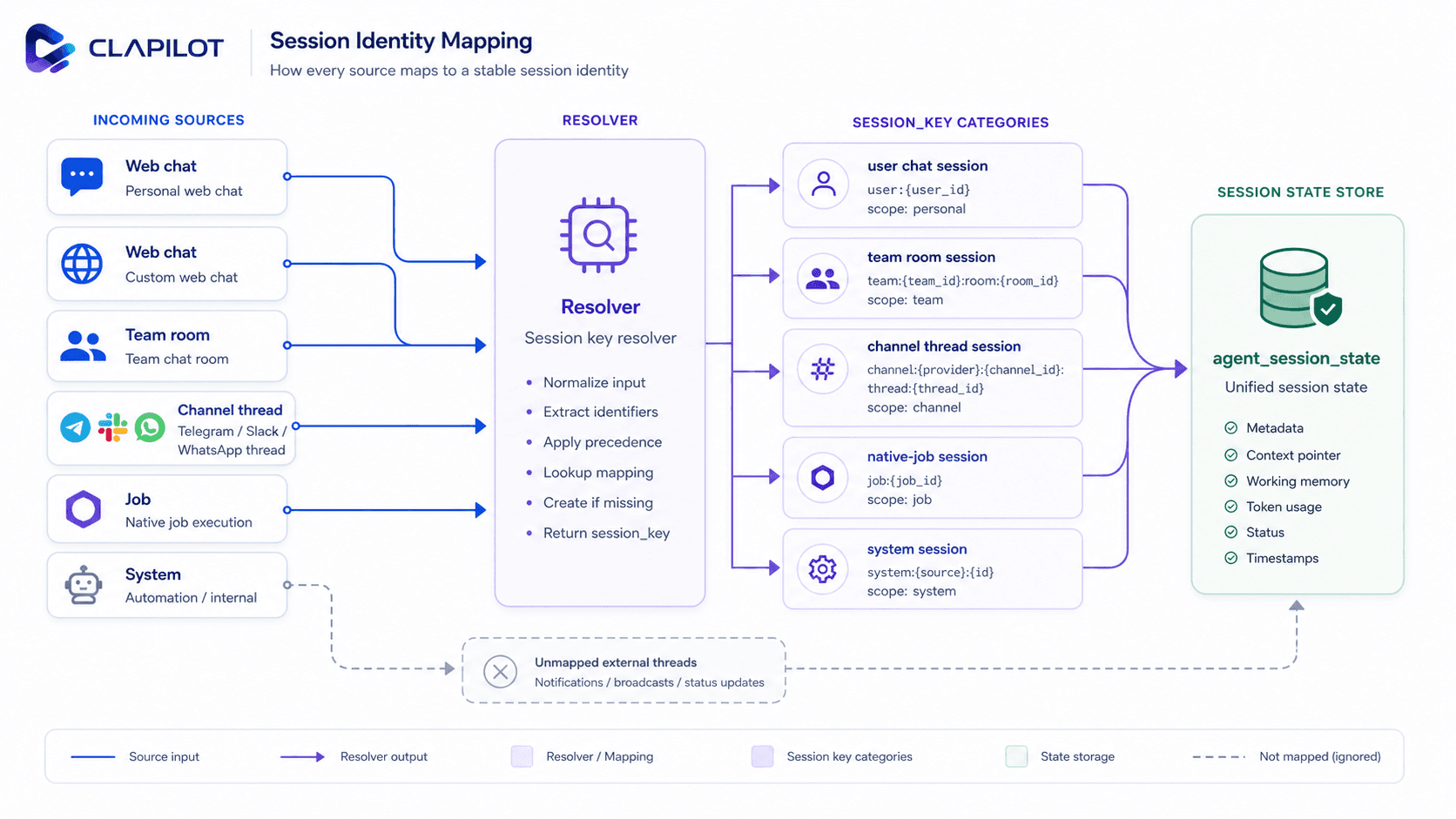
Maps web chats, team rooms, channel threads, jobs, and system automations into concrete native session keys and session state.
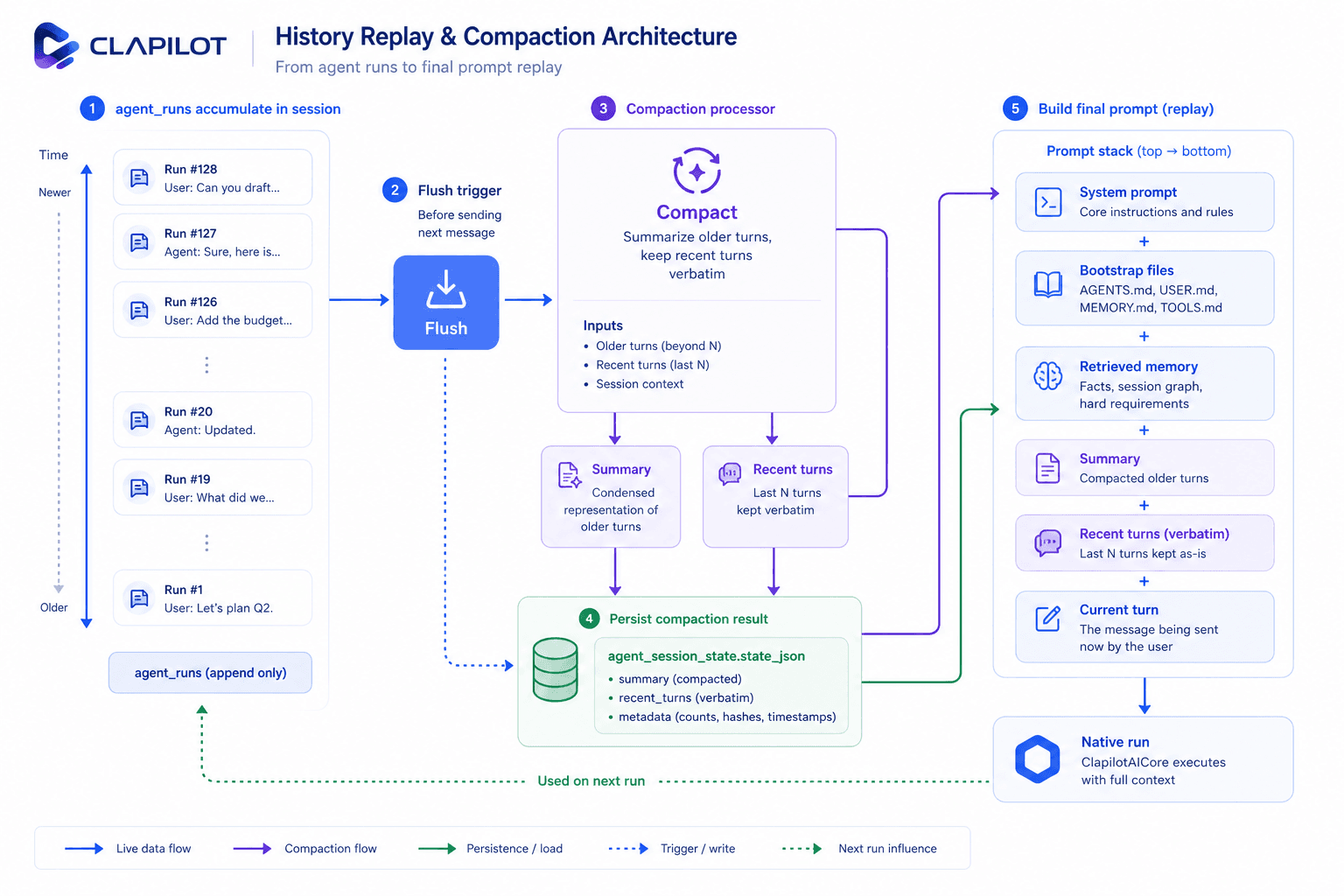
Explains how completed runs become replay context, when memory flush and compaction happen, and how the next provider prompt is assembled.
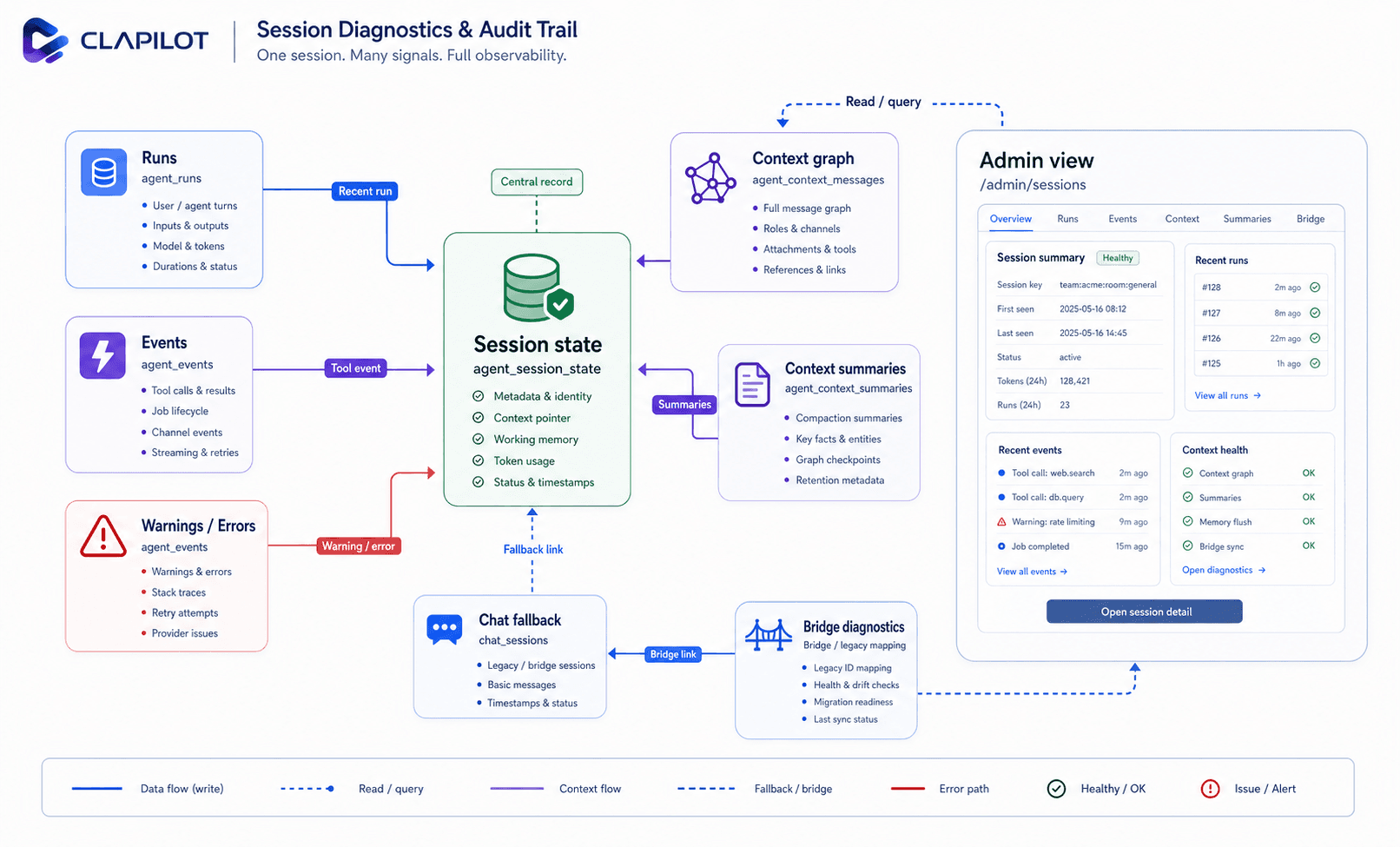
Connects session state to runs, events, context graph tables, chat fallbacks, bridge diagnostics, and the admin Sessions inspector.
Sessions are the native runtime’s continuity boundary. A session answers a practical question: "Should this new run remember the same things as the previous run?"
That boundary decides which runs belong together, which history is replayed, which compaction state is active (compaction = rewriting older turns into a persisted summary so long conversations still fit the model budget), which lossless context graph belongs to the conversation, and which shared memories are visible.
In day-to-day debugging, session identity is the first thing to verify when a chat, channel, or background job appears to remember too much, forget too much, or continue the wrong conversation.
Primary implementation:
services/clapilot-agent/src/sessions/index.mjssrc/lib/agent-runtime/sessions.ts
Core tables
The session layer writes to:
agent_session_statecurrent session identity and runtime stateagent_runsone row per execution attemptagent_eventslifecycle, tool, channel, and warning/error eventsagent_context_messages,agent_context_summaries,agent_context_itemslossless per-session context graph
For channel sessions it also uses:
agent_channel_threads
Session key formats
A session key is the string identity that groups runs into one conversation. The runtime supports multiple native session-key shapes:
| Shape | Used for | Notes |
|---|---|---|
agent:<agentId>:openai-user:<session_user> | Web chat, team chat, and mapped/approved channel threads | Compatibility key family that keeps continuity with the older OpenClaw-derived chat identity model |
agent:<specialistHandle>:openai-user:<chat-boundary> | Specialized agent runs | Isolates specialist history from the main agent's session |
channel:<channel>:<threadKey> | Unmapped Telegram/Slack/WhatsApp threads | Channel-local fallback identity before an approval maps the thread |
clapilot:group:<roomId> | Team-chat rooms (also the target of mapped channel groups) | Used as the session_user boundary inside the compatibility key |
native-job:<id> | Scheduled native jobs | One session per job |
heartbeat:user:<userId> / heartbeat:teamchat | Heartbeat runs | Dedicated per-scope sessions, see Heartbeat |
| system sessions | Runtime-owned background/system work | channel_type = system |
Examples of channel sessions: a Telegram chat/thread, a Slack thread, a WhatsApp chat or group JID, a Telegram DM mapped onto a specific user's main chat, or a Telegram/Slack/WhatsApp group mapped onto clapilot:group:<roomId>.
Session state lifecycle
Every run upserts a row in agent_session_state.
Important persisted fields:
session_keyuser_idchat_session_idgroup_room_idchannel_typechannel_thread_keyconfigured_modeleffective_modeleffective_provider_config_idbackend_providerprompt_files_hashbootstrap_metastate_jsonlast_run_idlast_activity_atcreated_at,updated_at
state_json is where the runtime stores operational session state such as:
- memory flush metadata
- compaction summary and counters
- other evolving maintenance state
The upsert behavior is additive:
- known fields such as
user_idandchat_session_idare preserved if a later run omits them state_jsonis merged instead of replaced
The runtime now also performs best-effort session self-healing on every new run:
- if an older session row is missing
user_id, it re-resolves the owning user fromchat_sessions - if
chat_session_idis missing, it re-resolves it from the compatibility session identity when possible - if
state_json.currentContextis stale or empty, it backfills a useful context from the current request or the most recent usable context for the same user
This matters because old sessions created before a context fix should recover on the next turn instead of forcing users to start a brand new chat.
Multi-user support
Multi-user support exists at the session table level through user_id.
Current behavior:
- web chat sessions usually carry a real Clapilot
user_id - unmapped channel sessions operate purely by external thread identity
- mapped channel DMs carry the linked Clapilot
user_idand reuse the chosen personal web-chat session boundary (Hauptchat by default, or a dedicated/picked session); the boundary is resolved live fromchat_session_id, so it follows session resets, and each DM turn is mirrored into that session's visible history - mapped channel groups carry the selected team-room identity and the built-in
global_team_serviceprincipal - session summaries can also store
user_id
This means the runtime can distinguish:
- one user with multiple web sessions
- many external channel threads with no authenticated app user
- system and job sessions outside normal user chat
Relation to chat_sessions
The native runtime does not replace Clapilot’s chat_sessions; it layers on top of them.
For web chat diagnostics, the app resolves the native session back to chat_sessions either by:
- direct
chat_session_id, or - deriving
openclaw_session_userfrom the compatibility-stylesession_key
That is why the Sessions admin page can show:
- native session state
- matching
chat_sessionsrow - fallback transcript from
chat_nachrichten - recent native runs and events together
Session keys on the filesystem
The runtime never uses raw session keys as filesystem names. Where per-session state must be written to disk — for example embedded-run attachment staging under .clapilotaicore/attachments/ — the directory name is a 16-hex-character SHA-256 prefix of the native session_key. This keeps filesystem state stable across restarts without exposing raw user/session identifiers as file names.
History replay
At run time, the session layer assembles context from:
- runtime system prompt
- bootstrap prompt files
- retrieved durable memory
- compacted session summary, if one exists
- recent completed run history
- current user message
Recent history is loaded from agent_runs, not only from the app chat transcript.
That matters because native channel and job sessions may never touch chat_sessions or chat_nachrichten.
Text-only native runs also persist input_payload.promptCacheReplay: the exact augmented provider turn containing that turn's runtime-generated time/retrieval/learning context and raw user request, together with a hash of the stable model/system/tool prefix. When the hash still matches, history replay uses the augmented turn instead of reconstructing its context, so the next provider request extends the previous serialized prompt and can reuse local KV/prefix cache. A changed stable prefix, compaction boundary, model, page context, or tool surface falls back to raw user/assistant replay and begins a new cache lineage. Older runs without replay metadata remain compatible through the same raw fallback.
Externally delivered assistant posts are merged into replayed run history when they were recorded in agent_context_messages with run_id IS NULL, role = assistant, and metadata.direction = output. This covers approved channel sends, team-chat automation delivery, and personal-chat automation delivery that land in a conversation without being the final output of that conversation's own run. These posts do not change run-count compaction bookkeeping, but their text and sent-media file references are included in prompt context.
Persistent subscription bridges also count those external output posts when deciding whether the conversation moved on after the last bridge turn. If a Codex or Claude CLI thread is resumed after an external assistant post, the runtime rebuilds the visible transcript instead of continuing the stale bridge thread with only the latest user message.
If the Codex app-server reports a persisted bridge thread as missing (thread not found / missing rollout), the run treats that as a recoverable stale provider binding. The stale agent_external_sessions row is closed and its provider thread/session reference is cleared only when the stored thread id still matches the failed thread, the original turn is replayed once on a newly created Codex bridge thread, and agent_events records run.thread_recovered with the old and new thread ids plus the recovery attempt count. A second stale-thread failure in the same run is not retried.
Lossless session graph
In addition to agent_runs, the runtime now keeps a lossless per-session context graph.
The graph stores:
- raw normalized turn items in
agent_context_messages - leaf and condensed summaries in
agent_context_summaries - ordered assembly state in
agent_context_items
The graph is not the same as agent_runs:
agent_runsis the audit trail for executionsagent_context_*is the context-management layer for later search and expansion
Cross-session shared memory
Cross-session recall no longer depends only on memory_scope.
agent_memories now also carries:
visibility_scopeprivate,team,workspace,channelsubject_refscontextual tags such asmandantId,documentId,taskId,moduleSlug,routePath,groupRoomId,channelThreadKey
Practical behavior:
- a finished session can write team-visible durable facts
- another authenticated session or active channel session can see them on the next model turn
- retrieval prefers entries whose
subject_refsmatch the active session context - when no structured
subject_refsmatch exists, strong lexical/entity matches can still surface team facts across sessions - unrelated contextual team memory is still de-prioritized
Session maintenance
Two maintenance passes run in the detached post-response pipeline when needed:
- memory flush
- history compaction
History compaction uses provider turns capped at 45 seconds and 4,000 input tokens by default. If a provider still times out or fails, the runtime writes a bounded deterministic continuity summary for that chunk, checkpoints it, and completes compaction instead of discarding the maintenance pass. lastDeterministicFallbackCount records that degraded-but-complete path in session state.
Neither pass may delay run.started or the foreground provider request. Runs use the last completed compaction summary and independently cap and token-fit recent history. Maintenance is single-flight per session; requests arriving during an active pass coalesce into one trailing pass with the latest completed transcript. Both passes write their status back into agent_session_state.state_json, and session.maintenance.completed records their background outcome.
The most important diagnostics exposed by session_status are:
- current channel/model
- runtime path / maintenance owner
- recent history depth
memory.flush.lastFlushedAtmemory.flush.lastFilePathsession.compaction.compactedThroughRunCountsession.compaction.summaryActivesession.compaction.lastCompactedAtmemory.shared.teamEntriesmemory.contextGraph.messagesmemory.contextGraph.summaries
Runs and events
agent_runs stores execution records such as:
- source type
chat,job,channel,email,heartbeat,api - status
queued,running,completed,failed,cancelled,timed_out - requested and effective model
- immutable initiating actor (
actor_user_id) when a user triggered the run - prompt files used
- tool calls
- output text
- usage
- error state (
error_code,error_message)
agent_events stores:
- channel ingress
- lifecycle markers
- tool events
- warnings and errors
This is the main audit trail for native runtime debugging.
agent_session_state.actor_user_id is intentionally mutable for a shared Team Chat session because it represents the member driving the current turn. Each new agent_runs row therefore snapshots that verified actor into its own actor_user_id; retries may fill a previously reserved null value but never replace an existing actor. Personal export authorization and tool-result redaction use this per-run identity, not the session's latest actor. Migration 255 backfills only recovery-envelope actors and stable non-Team session owners, leaving ambiguous historical Team Chat runs unattributed instead of guessing.
Interactive native chat/channel turns are serialized per session_key. If a
second turn arrives while another turn for the same session is active, the
runtime keeps it in a FIFO queue and starts it automatically after the active
turn completes instead of returning "Session verarbeitet bereits einen Turn".
Webchat rows remain visible as assistant_pending while their queued turn waits.
When the caller provides a stored chat messageId/idempotencyKey, agent_runs
stores it in input_payload.idempotencyKey; duplicates for the same session
reuse the existing in-flight or completed run instead of executing the message
twice.
Run lifecycle reconciliation
Because clapilot-agent is the only executor of agent_runs, a row that is still queued or running after a runtime restart can never complete on its own. The run reconciler (services/clapilot-agent/src/jobs/run-reconciler.mjs) keeps run state honest:
| Pass | When | Effect |
|---|---|---|
| Boot recovery | Once at service start | A pre-boot queued/running run with an idempotency key and persisted input_payload.recoveryEnvelope is atomically claimed with FOR UPDATE SKIP LOCKED, requeued on the same agent_runs.id, and resumed through the normal per-session FIFO. Restarts before execution do not consume the recovery budget; a durable run.restart_recovery.attempted event written immediately before execution does. At most three executed recoveries are allowed, preventing poison-pill crash loops while permitting recovery across repeated pre-execution restarts. Tool activity before the restart never disqualifies a chat/channel turn: the resumed turn receives a bounded checkpoint (latest 120 tool.* events with tool name, call id, command, error flag, and result preview, per-event caps of 400/2000 chars and an aggregate budget of 24 000 chars that compacts results and then drops the oldest calls first) as a system message, so completed shell commands and side effects are treated as authoritative instead of being repeated. The aggregate budget is additionally sized per model: the checkpoint may use at most 25 % of the selected model's prompt budget (never below 2 000 chars, never above the 24 000-char cap), and the checkpoint text is counted as part of the current request when the runtime fits static prompt layers, trims stored history, and validates the provider context window, so a resumed turn on a small-context model cannot overflow the model just because of the checkpoint. Every external send/publish/book tool (emails_send_draft, channel_send_message, calendar_*, x_create_post, package_install, ...) that was invoked before the restart is blocked on the resumed turn regardless of whether its completion was persisted, and regardless of whether the call still fits into the bounded checkpoint: the block is derived from an unbounded per-run aggregate of the side-effect tool events (covering every earlier recovery attempt on the same run id), never from the 120-event checkpoint window. A durably errored completion (isError: true) keeps the tool blocked as well, because the error may have surfaced after the external effect happened; the checkpoint still marks that call failed so the turn can report the outcome and ask the user to retry explicitly. Shell/command tools (exec_command, bash, ..., plus the workspace file writers edit_lines and write_file, whose interrupted calls carry no read-only command and therefore always count as unsafe) are blocked for the resumed turn when a command that is not a replay-safe read-only research command (cat/grep/sed -n/non-writing curl pipelines) has a durable start without a durable completion: re-running the command would be the only way to "verify" it, so the interrupted command is reported as indeterminate instead. Completed commands and interrupted read-only commands keep the shell available. The names are merged into the run's module gate set, so they are absent from every tool surface the model sees and denied at execution time through the persisted contextual tool gate (contextual_tool_not_allowed:<tool>), not only discouraged by the checkpoint prompt. The attempt event lists them as blockedToolNames; the subset whose start has no durable completion is additionally reported as indeterminateToolNames. Both lists are also passed into the resumed turn and rendered as explicit header lines of the checkpoint system message, so the turn knows which tools are unavailable and which side effect must be verified with the user even when the aggregate budget compacted that call out of the checkpoint's call list. If the original request still needed another call of a blocked tool, the resumed turn reports what was completed and asks the user to continue explicitly. To make this checkpoint reliable, external side-effect tool starts are persisted with the same fail-closed contract as shell tool starts: a failed agent_events insert aborts the tool call before it executes. Orchestrator turns keep their stricter repository/forge verification. Default-branch CI diagnostic turns have a repo/head-derived durable session key but no forge write credential: a verified pre-turn checkout can replay, while a locally committed, unpushed candidate cannot resume the module-owned publication gate and remains fail-closed. Pushed commits and matching pull requests are reconciled only with conclusive forge evidence. Invalid lookup preconditions, unexpected HTTP responses, missing local evidence, and unavailable forge state remain fail-closed. Attempt events are followed by completed or failed; a pre-execution abort emits skipped instead. Events include attempt, maxExecutedAttempts, and reason; completion also reports status and deduped, while failure/skip events include error and errorCode. A superseded orchestrator turn is cancelled with error_code = 'restart_recovery_superseded'; other execution failures use restart_recovery_failed. Heartbeat policy skips remain cancellation-only. |
| Boot reconcile fallback | After recovery claims | A run without a recovery envelope (legacy rows, or job/heartbeat/API runs without an idempotency key) is marked failed with error_code = 'orphaned_restart'. A recovery envelope that already has three durable execution attempts is marked failed with error_code = 'restart_recovery_exhausted' and emits run.restart_recovery.exhausted without another attempt event. |
| Stuck sweep | Every CLAPILOT_AGENT_RUN_SWEEP_MS (default 10 min, min 60 s) | Runs whose updated_at has not moved for CLAPILOT_AGENT_RUN_MAX_AGE_MINUTES (default 360, min 30) are marked failed with error_code = 'stuck_timeout' |
Long tool-heavy runs keep refreshing updated_at through run patches, so the stuck sweep only catches genuinely dead executions (hung provider call, lost worker).
Every persisted user-facing chat, group_chat, and channel turn carries an
idempotency key. Callers of /internal/runs, /internal/chat/completions, and
/internal/responses can pass idempotencyKey/messageId (also
clientMessageId and snake_case variants); a user-facing turn without one
receives the durable fallback key restart-recovery:<run id> before its run row
is created, so the recovery envelope is always persisted and no chat/channel
order is orphaned by a restart. Eligibility is decided on the caller's explicit
sourceType value, not on the persisted default: internal helper traffic such
as session titles, auto-flow summaries, or calendar prefill that omits
sourceType or uses another value is stored as chat but gets no fallback key
and no recovery envelope, because nobody waits for a boot replay of it.
The recovery envelope contains normalized messages including image/file attachment
parts, identity/session scope, model, tool profile, and UI context, but no stream
callbacks or provider secrets. Graceful
shutdown changes recoverable active rows back to queued instead of terminally
cancelling them. A recovered result includes a localized restart notice, and the
existing chat read-time reconciliation backfills that result when the original
browser stream no longer exists. Mutating operations still require their own stable
idempotency boundary: Canvas PDF export uses the durable run ID as
dokumente.agent_idempotency_key, a unique owner-scoped database key, and a stable
PDF path so replay cannot create a second Documents row. Canvas file creation and
template rendering likewise derive a deterministic file path from the durable run
and operation arguments, so replay updates the original artifact instead of
allocating a second filename.
The app side complements this with read-time self-healing of chat placeholders: when a personal or group chat transcript is loaded, assistant messages still flagged assistant_pending whose row has not been touched for 30 minutes (personal chat, chat_nachrichten) or 15 minutes (group chat, chat_group_messages) are expired — the pending flag is cleared, an interruption notice is filled in when the answer is empty, and message_meta.assistantRunExpired is set. "Preparing response" bubbles therefore cannot survive web or agent-runtime restarts forever.
Completion judge provider boundary
The autonomous completion judge uses the effective model reference returned by
the run (or its selected reference when no result reference exists), with provider
fallbacks disabled and requireExactModel: true. The provider loop checks the
canonical reference after refreshing configuration and rejects a substituted
default with PROVIDER_EXACT_MODEL_UNAVAILABLE before sending evidence.
A judge failure follows the existing unavailable/uncertified
diagnostic path; it must not silently send task text, answers, or tool evidence to
another provider. The orchestrator goal judge already disables provider fallbacks
through runSingleCompletion.
Session admin page
The ClapilotAICore Sessions page is designed as a diagnostics view over the native session layer plus channel-bound interactive bridge sessions.
In addition to rows backed by agent_session_state, the page now also includes thread-bound Agent Orchestrator / Codex app-server sessions from agent_external_sessions when a Telegram, Slack, or WhatsApp thread was routed into the interactive coding path before a native agent_session_state row existed.
It exposes:
- session identity classification
webchat,group,channel,job,system - execution-harness diagnostics in addition to the session runtime path
the persisted bridge provider adapters are
embedded_pi,claude_cli_bridge,codex_app_server, andacp_agent(shown asClapilot-code (Coding),Claude CLI Bridge,Codex App Server, andClaude Code Agent); the internal adapter value remains unchanged - bridge-session diagnostics when applicable provider adapter, bridge status, preferred harness session id, repo, workspace, external thread id, and external session id
- user and chat-session mapping
- current model assignment
- runtime path
native,embedded_pi, ororchestrator_bridge; the first two unchanged wire values are displayed as Clapilot-code (Assistant) and Clapilot-code (Coding) - run counters and last status
- last observed prompt-budget telemetry context-window size, prompt-budget size, estimated prompt load, replayed-tail size, provider token usage, and model-limit source
- session-maintenance telemetry compaction counts, compaction engine, last trigger, last compacted turn counts, memory-flush counts, skip reasons, and summary-active state
- current safeguard strategy snapshot shipped model-fallback usage vs generic emergency fallback, flush threshold, preserved-tail size, compaction summary target, retry guard, and lossless-context thresholds
- shared fact counts
- lossless context graph counts
- persisted compaction summary preview
- raw
bootstrap_meta - raw
state_json - recent runs/events
- fallback app transcript when applicable
Use this page when you need to answer questions like:
- why did a channel thread reuse an old context?
- which model actually answered in this session?
- did compaction already happen?
- how full was the prompt budget on the last observed run?
- how often did memory flush / compaction fire for this session?
- did the native runtime compact, or did the embedded runtime own the compaction cycle?
- which coding harness actually answered this session, and what external session/thread id is it currently bound to?
- is this session tied to a Clapilot user or only to an external thread?
Preserving interrupted repository work
Before an embedded orchestrator turn executes, its session metadata persists a
restartRecoveryBinding containing the turn, repository, workspace directory,
baseline branch and baseline commit. The run recovery envelope retains the same
session/turn identifiers and workspace. Recovery rejects a mismatching binding
or an unavailable checkout; it never creates a replacement workspace.
Recovery inspects tracked and untracked changes as well as Git heads and forge
publication. A published HEAD does not complete a turn while further local files
remain changed, including when a previous sweep cached publication evidence.
When its command evidence passes the recovery guard, the existing session
continues with those files and its tool checkpoint. A push
without a PR can continue only when origin advertises the exact intended branch
and commit and both commit and branch PR lookups conclusively report absence.
A conflicting PR or unavailable/malformed forge response does not count as absence.
Only a simple single-ref git push [-u|--set-upstream] origin HEAD:<branch> can
use that exact remote evidence to resolve an interrupted command. Other external
side effects and arbitrary shell scripts retain their existing replay guards.
Literal printf/echo overwrites may continue when the existing file bytes
exactly match the command, including a write followed by git diff -- <same-path> and a trailing background
operator. The file and command working directory must remain inside the verified
workspace; symlinks, hard links, appends, expansions and additional commands are
rejected. Recovery retains each command’s workdir/cwd when loading persisted
events so evidence is checked against the file the command actually targeted.
A plain numeric sleep may be interrupted without blocking repository-verified recovery because it has
no side effects. Prior commands remain in the recovery checkpoint and must not
be blindly repeated. Validation scripts such as npm run build still require
manual continuation because Git evidence cannot verify their possible external
side effects.
Before execution or failure, run.restart_recovery.repository_checked persists
repo, workspace, session/turn, baseline, current branch/commit, dirty state,
remote head, PR URL and the verification outcome in agent_events. Failure events
also retain these diagnostics. The resumed prompt requires preserving local
files, inspecting the diff and rechecking/reusing the existing branch and PR.
No credentials or command output are included in this repository checkpoint.
Regression validation: npx vitest run services/clapilot-agent/src/orchestrator-sessions/recovery-integration.test.mjs services/clapilot-agent/src/jobs/run-reconciler.test.mjs.
The integration cases use real local repositories and a bare origin, clear the
in-memory broker, and invoke the boot reconciler and session preparation. SQL,
forge HTTP and model execution are test doubles; no real PR is created.
Related docs: